Epidemiological Profile of Onychomycoses at Mohammed V Military Teaching Hospital (HMIMV), Rabat, Morocco, 2024–2025
DOI:
https://doi.org/10.63095/NBSEH.26.010922Keywords:
Onychomycosis, Trichophyton rubrum, Diabetes, Mycology, MoroccoAbstract
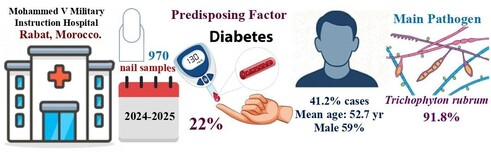
A retrospective study in the Parasitology–Mycology Department of Mohammed V Military Teaching Hospital from 01/01/2024 to 01/01/2025 examined 970 nail samples taken for suspected onychomycosis. Four hundred cases were confirmed (41.24%). The mean age was 52.73 ± 16.52 years (2–93 years), with a male predominance (59%, sex ratio 1.44). Patients aged 51–60 years (26.0%) and 61–70 years (20.75%) made up nearly half of the cohort. Diabetes was the main predisposing factor (22%), far ahead of iatrogenic immunosuppression (6.5%); HIV infection was exceptional (0.25%). Most positive samples came from the foot (80.75%). The delay between lesion onset and sampling was under ten years in most cases (mean 5.55 years). Dermatophytes predominated (91.75%), almost exclusively Trichophyton rubrum (91.0%), followed by yeasts (7.75%, mainly Candida albicans); non-dermatophytic moulds were rare (0.5%). Yeasts dominated fingernail samples (77.5%), whereas plantar onychomycosis remained dermatophytic. This profile shows a marked dermatophytic pattern shaped by age and cardiometabolic conditions.
Downloads
References
Gupta, A.K., Wang, T., Ravi, S.P., Mann, A., & Bamimore, M.A., 2024, Global prevalence of onychomycosis in general and special populations: An updated perspective. Mycoses 67(4). https://doi.org/10.1111/myc.13725
Nenoff, P., Reinel, D., Mayser, P., Abeck, D., Bezold, G., Bosshard, P.P., Brasch, J., Daeschlein, G., Effendy, I., Ginter‐Hanselmayer, G., Gräser, Y., Hamm, G., Hengge, U., Hipler, U., & Höger., U., 2023, S1 Guideline onychomycosis. Journal Der Deutschen Dermatologischen Gesellschaft 21(6), 678-692. https://doi.org/10.1111/ddg.14988
World Health Organization, 2022, WHO fungal priority pathogens list to guide research , development and public health action. https://iris.who.int/server/api/core/bitstreams/69af4379-4f27-4ac4-8973-74d7b52af7bd/content
Gupta, A.K., Wang, T., Ravi, S.P., Mann, A., Lincoln, S.A., Foreman, H., & Bakotic, W.L., 2024, Epidemiology of Onychomycosis in the United States Characterized Using Molecular Methods, 2015–2024. Journal of Fungi 10(9), 633. https://doi.org/10.3390/jof10090633
Leung, A.K., Lam, J.M., Leong, K.F., Hon, K.L., Barankin, B., Leung, A.A., & Wong, A.H., 2019, Onychomycosis : An updated review. Recent Patents On Inflammation & Allergy Drug Discovery 14(1), 32-45. https://doi.org/10.2174/1872213x13666191026090713
Lim, S.S., Ohn, J., & Mun, J., 2021, Diagnosis of Onychomycosis: From Conventional Techniques and Dermoscopy to Artificial Intelligence. Frontiers In Medicine 8. https://doi.org/10.3389/fmed.2021.637216
Halim, I., El Kadioui, F., & Soussi Abdallaoui, M., 2013, Onychomycosis in Casablanca (Morocco). Journal of Mycology and Medical Mycology 23(1), 9–14. https://doi.org/10.1016/j.mycmed.2012.10.002
Seck, M. C., Ndiaye, D., Diongue, K., Ndiaye, M., Badiane, A. S., Sow, D., Sylla, K., Tine, R., Ndiaye, J. L., Faye, B., & Ndir, O., 2014, Mycological profile of onychomycosis in Dakar (Senegal). Journal of Mycology and Medical Mycology 24(2), 124–128. https://doi.org/10.1016/j.mycmed.2014.02.002
Kouotou, E. A., Kechia, F.A., Iwewe Somo, Y., Nguena Feungue, U., Nansseu, J. R., & Moyou Somo, R. (2017). Profil mycologique des onychomycoses vues en consultation de dermatologie à Yaoundé, Cameroun. Journal de Mycologie Médicale, 27(2), 238–244. https://doi.org/10.1016/j.mycmed.2017.03.002
Konaté, A., Yavo, W., Kassi, K. F., Djohan, V., Angora, K. E., Bosson-Vanga, H., Barro-Kiki, P. C. M., & Menan, E. I. H., 2014, Mycological profile of onychomycosis in Abidjan (Ivory Coast). Journal of Mycology and Medical Mycology 24(3), 205–210. https://doi.org/10.1016/j.mycmed.2014.03.001
El Abbassi, M., Boughroud, H., Amarir, F., Rhajaoui, M., Adlaoui, E. B., Mkinsi, H., Baha, I., & Rais, S., 2023, Clinical and epidemiological study of onychomycosis among patients of the National Institute of Hygiene in Rabat, Morocco (2016–2020). Current Medical Mycology 9(4), 39–46. https://doi.org/10.22034/CMM.2024.345174.1492
Ben Youssef, A. B., Kallel, A., Azaiz, Z., Jemel, S., Bada, N., Chouchen, A., Belhadj-Salah, N., Fakhfakh, N., Belhadj, S., & Kallel, K., 2018, Onychomycosis: Which fungal species are involved? Experience of the Laboratory of Parasitology-Mycology of the Rabta Hospital of Tunis. Journal of Mycology and Medical Mycology 28(4), 651–654. https://doi.org/10.1016/j.mycmed.2018.07.005
Nzenze Afène, S., Ngoungou, E.B., Mabika, M.M., Bouyou-Akotet, M.K., Avome-Mba, I.M., & Kombila, M., 2011, Onychomycosis in Gabon: clinical and mycological aspects. Journal of Mycology and Medical Mycology 21(4), 248–255. doi:10.1016/j.mycmed.2011.09.005
El Abbassi, M., Boughroud, H., Amarir, F., Rhajaoui, M., Adlaoui, E. B., Mkinsi, H., Baha, I., & Rais, S., 2023, Clinical and epidemiological study of onychomycosis among patients of the National Institute of Hygiene in Rabat, Morocco (2016–2020). Current Medical Mycology 9(4), 39–46. doi:10.22034/CMM.2024.345174.1492
Lim, S. S., Chua, M., Sahu, K., & Lim, Y. L., 2021, Diagnosis of Onychomycosis: From conventional techniques to molecular tools. Journal of Fungi 7(6), 435. https://doi.org/10.3390/jof7060435
Dhib, I., Fathallah, A., Yaacoub, A., Zemni, R., Gaha, R., Said, M.B., 2012, Clinical and mycological characteristics of onychomycosis in central Tunisia: a 22-year retrospective study (1986–2007). Mycoses 56(3), 273–280. https://doi.org/10.1111/myc.12016
Diongue, K., Ndiaye, M., Seck, M. C., Diallo, M. A., Badiane, A. S., & Ndiaye, D., 2017, Onychomycosis Caused by Fusarium spp. in Dakar, Senegal: Epidemiological, Clinical, and Mycological Study. Dermatology Research and Practice 2017. https://doi.org/10.1155/2017/1268130
Zafindraibe, N. J., Tsatoromila, F. A. M., Rakotoarivelo, Z. H., Rakotozandrindrainy, N., Rafalimanana, C., Rakoto-Alson, O. A., & Razanakolona, L. R., 2021, Onychomycosis: experience of the laboratory of parasitology-mycology of CHU-Joseph Ravoahangy Andrianavalona, Antananarivo, Madagascar. Pan African Medical Journal 40, 176. https://doi.org/10.11604/pamj.2021.40.176.25216
Lipner, S. R., & Scher, R. K., 2018, Onychomycosis. Journal of the American Academy of Dermatology 80(4), 853–867. https://doi.org/10.1016/j.jaad.2018.05.1260
Frazier, W. T., Santiago-Delgado, Z. M., & Stupka, K. C. II, 2021, Onychomycosis: Rapid Evidence Review. American Family Physician. https://www.aafp.org/pubs/afp/issues/2021/1000/p359.html
Thomas, J., Jacobson, G. A., Narkowicz, C. K., Peterson, G. M., Burnet, H., & Sharpe, C., 2010, Toenail onychomycosis: An important global disease burden. Journal of Clinical Pharmacy and Therapeutics 35(5), 497–519. https://doi.org/10.1111/j.1365-2710.2009.01107.x
Vasconcellos, C., Pereira, C. Q. M., Souza, M. C., Pelegrini, A., Freitas, R. S., & Takahashi, J. P., 2013, Identification of fungi species in the onychomycosis of institutionalized elderly. Anais Brasileiros de Dermatologia 88(3), 377–380. https://doi.org/10.1590/abd1806-4841.20131884
Sigurgeirsson, B., & Baran, R., 2013, The prevalence of onychomycosis in the global population – A literature study. Journal of the European Academy of Dermatology and Venereology 28(11), 1480–1491. https://doi.org/10.1111/jdv.12323
Vestergaard-Jensen, S., Mansouri, A., Jensen, L. H., Jemec, G. B. E., & Saunte, D. M. L., 2022, Systematic review of the prevalence of onychomycosis in children. Pediatric Dermatology 39(6), 855–865. https://doi.org/10.1111/pde.15100
Ward, H., Parkes, N., Smith, C., Kluzek, S., & Pearson, R., 2022, Consensus for the treatment of tinea pedis: A systematic review of randomized controlled trials. Journal of Fungi 8(4), 351. https://doi.org/10.3390/jof8040351
Ameen, M., Lear, J. T., Madan, V., Mohd Mustapa, M. F., Richardson, M., Hughes, J. R., Sahota, A., Griffiths, M., McDonagh, A. J., Punjabi, S., Buckley, D. A., Nasr, I., Swale, V. J., Duarte Williamson, C. E., McHenry, P. M., Levell, N. J., Leslie, T., Mallon, E., Towers, K., Davis, R., Saunders, C., Haveron, S. E., & Exton, L. S., 2014, British Association of Dermatologists’ guidelines for the management of onychomycosis 2014. British Journal of Dermatology 171(5), 937–958. https://doi.org/10.1111/bjd.13358
Gupta, A. K., Liddy, A., Magal, L., Shemer, A., Cooper, E. A., Saunte, D. M. L., & Wang, T., 2025, Onychomycosis in diabetics: A common infection with potentially serious complications. Life 15(8), 1285. https://doi.org/10.3390/life15081285
Navarro-Pérez, D., Tardáguila-García, A., García-Oreja, S., López-Moral, M., García-Madrid, M., & Lázaro-Martínez, J. L., 2023, Onychomycosis associated with diabetic foot syndrome: A systematic review. Mycoses 66(6), 459–466. https://doi.org/10.1111/myc.13577
Shah, V., Desai, A., & Lipner, S., 2024, Retrospective analysis of onychomycosis risk factors using the 2003–2014 National Inpatient Sample. Dermatology Practical & Conceptual 14(2), e2024074. https://doi.org/10.5826/dpc.1402a74
Bang, C. H., Yoon, J. W., Lee, H. J., Lee, J. Y., Park, Y. M., Lee, S. J., & Lee, J. H., 2018, Evaluation of relationships between onychomycosis and vascular diseases using sequential pattern mining. Scientific Reports 8(1), Article 35909. https://doi.org/10.1038/s41598-018-35909-z
Downloads
Additional Files
Published
How to Cite
Issue
Section
License
Copyright (c) 2026 Kholoud Maafi, Hamza Abidar, Marwa Nabil, Hafida Naoui, Badre Eddine Lmimouni

This work is licensed under a Creative Commons Attribution-NonCommercial 4.0 International License.
This work is licensed under a Creative Commons Attribution-NonCommercial 4.0 International License (CC BY-NC 4.0).
Readers may copy, distribute, and adapt the work for non-commercial purposes, provided the original author and source are credited.
For full licence details, please visit https://creativecommons.org/licenses/by-nc/4.0/.