The Effect of Applying Different Doses of Biochar on Amaranth and Sorghum Seedlings Grown in Black Soil
DOI:
https://doi.org/10.63095/NBSEH.26.773234Keywords:
Amaranth, Sorghum, Biochar, Black soil, Germination, Biomass growthAbstract
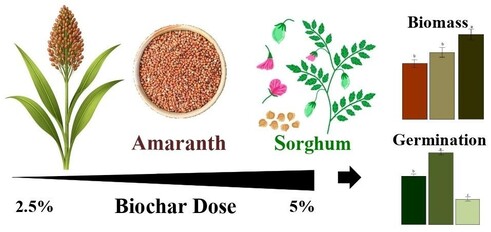
Biochar shows broad potential for use as a soil amendment. The success of its application relies on the optimal dose and the type of plant grown. The use of biochar delayed the germination of amaranth seeds. Subsequent seedling development was significantly better than the control values in both experimental treatments (biochar application doses of 2.5% and 5%). In the experiment with sorghum, plants had a positive response only under a relatively small dose of the amendment (2.5%). In addition, both doses of biochar slowed down and reduced germination of sorghum seeds.
Downloads
References
Groot, H., Fernholz, K., Frank, M., Howe, J., Bowyer, J., & Bratkovich, S., 2016, Biochar 101: An introduction to an ancient product offering modern opportunities (Minneapolis, MN: Dovetail Partners, Inc.). https://www.dovetailinc.org/report_pdfs/2016/dovetailbiochar0316.pdf
Ahmad, M., Rajapaksha, A., Lim, J., Zhang, M., Bolan, N., Mohan, D., Vithanage, M., Lee, S., & Ok, Y., 2014, Biochar as a sorbent for contaminant management in soil and water: A review. Chemosphere 99, 19-33. https://doi.org/10.1016/j.chemosphere.2013.10.071
Weber, K., & Quicker, P., 2018, Properties of biochar. Fuel 217, 240-261, https://doi.org/10.1016/j.fuel.2017.12.054
Bamdad, H., Hawboldt, K., & MacQuarrie, S., 2018, A review on common adsorbents for acid gases removal: Focus on biochar. Renewable and Sustainable Energy Reviews 81 (2). 1705–1720. https://doi.org/10.1016/j.rser.2017.05.261
Cha, J., Park, S., Jung, S., Ryu, C., Jeon, J., Shin, M., & Park, Y., 2016, Production and utilization of biochar: A review. Journal of Industrial and Engineering Chemistry 40, 1–15. https://doi.org/ 10.1016/j.jiec.2016.06.002
Al-Wabel, M., Al-Omran, A., El-Naggar, A., Nadeem, M., & Usman, A., 2013, Pyrolysis temperature induced changes in characteristics and chemical composition of biochar produced from conocarpus wastes. Bioresource Technology 131, 374-379. https://doi.org/10.1016/j.biortech.2012.12.165
Gul, S., Whalen, J.K., Thomas, B. W., Sachdeva, V., & Deng, H., 2015, Physico-chemical properties and microbial responses in biochar-amended soils: mechanisms and future directions.Agriculture, Ecosystems & Environment 206, 46-59. https://doi.org/10.1016/j.agee.2015.03.015
Zhang, H., Voroney, R.P., & Price, G.W., 2015, Effects of temperature and processing conditions on biochar chemical properties and their influence on soil C and N transformations. Soil Biology and Biochemistry 83, 19-28. https://doi.org/10.1016/j.soilbio.2015.01.006
Chintala, R., Mollinedo, J., Schumacher, T.E., Malo, D.D., & Julson, J.L., 2014, Effect of biochar on chemical properties of acidic soil. Archives of Agronomy and Soil Science 60(3). 393-404. https://doi.org/10.1080/03650340.2013.789870
Singh, H., Northup, B.K., Rice, C.W., & Prasad, P.V., 2022, Biochar applications influence soil physical and chemical properties, microbial diversity, and crop productivity: a meta-analysis Biochar 4(1), 8. https://doi.org/10.1007/s42773-022-00138-1
Solaiman, Z.M., Murphy, D.V., & Abbott, L.K., 2012, Biochars influence seed germination and early growth of seedlings. Plant and soil 353, 273-287. https://doi.org/10.1007/s11104-011-1031-4
Visioli, G., Conti, F.D., Menta, C., Bandiera, M., Malcevschi, A., Jones, D.L., & Vamerali, T., 2013, Assessing biochar ecotoxicology for soil amendment by root phytotoxicity bioassays. Environ Monit Assess 188, 166. https://doi.org/10.1007/s10661-016-5173-y
Zhang, K., Wang, Y., Mao, J., & Chen, B., 2020, Effects of biochar nanoparticles on seed germination and seedling growth. Environmental pollution 256, 113409. https://doi.org/10.1016/j.envpol.2019.113409
Li, Y., Shen, F., Guo, H., Wang, Z., Yang, G., Wang, L., Zhang, Y., Zeng, Y, & Deng, S., 2015, Phytotoxicity assessment on corn stover biochar, derived from fast pyrolysis, based on seed germination, early growth, and potential plant cell damage. Environmental Science and Pollution Research 22, 9534-9543. https://doi.org/10.1007/s11356-015-4115-5
Das, S.K., Ghosh, G.K., & Avasthe, R., 2020, Ecotoxicological responses of weed biochar on seed germination and seedling growth in acidic soil. Environmental Technology & Innovation 20, 101074. https://doi.org/10.1016/j.eti.2020.101074
Chrysargyris, A., Prasad, M., Kavanagh, A., & Tzortzakis, N., 2020, Biochar type, ratio, and nutrient levels in growing media affects seedling production and plant performance. Agronomy 10(9), 1421. https://doi.org/10.3390/agronomy10091421
Fang, J., Zhan, L., Ok, Y., & Gao, B., 2018, Minireview of potential applications of hydrochar derived from hydrothermal carbonization of biomass. Journal of Industrial and Engineering Chemistry 57, 15-21. https://doi.org/10.1016/j.jiec.2017.08.026
Persaud, T., Homenauth, O., Fredericks, D., & Hamer, S., 2018, Effect of rice husk biochar as an amendment on a marginal soil in Guyana. World Environment 8(1), 20-25. https://doi.org/10.5923/j.env.20180801.03
Yu, H., Zou, W., Chen, J., Chen, H., Yu, Z., Huang, J., & Gao, B., 2019, Biochar amendment improves crop production in problem soils: A review. Journal of environmental management 232, 8-21. https://doi.org/10.1016/j.jenvman.2018.10.117
Wang, Y., Lin, Q., Liu, Z., Liu, K., Wang, X., & Shang, J., 2023, Salt-affected marginal lands: a solution for biochar production. Biochar 5(1), 21. https://doi.org/10.1007/s42773-023-00219-9
R Core Team, 2023, R: A language and environment for statistical computing. R Foundation for Statistical Computing, Vienna, Austria. https://www.R-project.org/
Videgain-Marco, M., Marco-Montori, P., Martí-Dalmau, C., Jaizme-Vega, M.d.C., Manyà-Cervelló, J.J., & García-Ramos, F.J., 2020, Effects of Biochar Application in a Sorghum Crop under Greenhouse Conditions: Growth Parameters and Physicochemical Fertility. Agronomy 10, 104. https://doi.org/10.3390/agronomy10010104
Laghari, M., Mirjat, M.S., Hu, Z., Fazal, S., Xiao, B., Hu, M., Chen, Z., & Guo, D., 2015, Effects of biochar application rate on sandy desert soil properties and sorghum growth. Catena 135, 313-320. https://doi.org/10.1016/j.catena.2015.08.013
Islam, Md.M., Jalal, Md.S., Islam, Md.S., Hossain, Md.M., Işik, M., & Iqbal, Md.T., 2020, Akha biochar enhances soil fertility and productivity of red amaranth plant. Net Journal of Agricultural Science 8(1), 1-7. https://www.netjournals.org/pdf/NJAS/2020/1/20-011.pdf
Downloads
Additional Files
Published
How to Cite
Issue
Section
License
Copyright (c) 2026 Mykola Kharytonov, Nadia Martynova, Alla Samarska

This work is licensed under a Creative Commons Attribution-NonCommercial 4.0 International License.
This work is licensed under a Creative Commons Attribution-NonCommercial 4.0 International License (CC BY-NC 4.0).
Readers may copy, distribute, and adapt the work for non-commercial purposes, provided the original author and source are credited.
For full licence details, please visit https://creativecommons.org/licenses/by-nc/4.0/.