Potential Use of Sargassum Muticum as a Source of Plant Biostimulants for the Germination and Growth of Radish (Raphanus sativus L.) Through the Application of Eco-Friendly Extracts for Sustainable Agriculture
DOI:
https://doi.org/10.63095/NBSEH.26.150470Keywords:
Sargassum muticum, Seaweed biostimulant, Raphanus sativus, Sustainable agriculture, Plant growth promotionAbstract
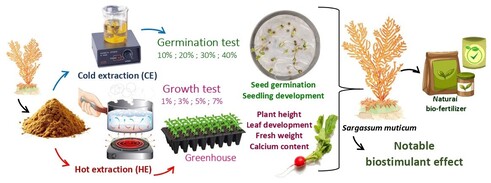
In recent years, seaweed has gained increasing attention for its biostimulatory properties, offering sustainable alternatives to synthetic fertilizers and pesticides. This study evaluated the biostimulant potential of the alien brown alga Sargassum muticum on seed germination and the growth of radish plants (Raphanus sativus L.) through in vitro assays and greenhouse experiments under natural conditions. Two eco-friendly extracts (hot and cold) were prepared and applied at different concentrations. Low extract concentrations (10% and 20%) significantly enhanced seed germination and early seedling growth, notably stem length and fresh biomass. Under greenhouse conditions, treated plants showed increased total height, leaf development, fresh weight, and calcium content, with the most pronounced effects observed with the high-concentration cold extract (7%). These findings highlight the strong biostimulant potential of S. muticum and support its use as a natural biofertilizer for sustainable agriculture.
Downloads
References
Barragán, J.M., De Andrés, M., 2015, Analysis and trends of the world’s coastal cities and agglomerations. Ocean and Coastal Management 114, 11–20. https://doi.org/10.1016/j.ocecoaman.2015.06.004
Van Ittersum, M.K., Van Bussel, L.G.J., Wolf, J., Grassini, P., Van Wart, J., Guilpart, N., Claessens, L., 2016, Can sub-Saharan Africa feed itself? Proceedings of the National Academy of Sciences 113(52), 14964–14969. https://doi.org/10.1073/pnas.1610359113
Gurjar, R. K., 1987, Irrigation for agricultural modernization: A study of the Indira Gandhi Canal Command Area, Stage I. (Jodhpur: Scientific Publishers). https://www.cabidigitallibrary.org/doi/full/10.5555/19871844430
Chen, X.P., Zhang, F., Römheld, V., Horlacher, D., Schulz, R., Böning-Zilkens, M., Wang, P., Claupein, W., 2006, Synchronizing N supply from soil and fertilizer and N demand of winter wheat by an improved Nmin method. Nutrient Cycling in Agroecosystems 74, 91–98. https://doi.org/10.1007/s10705-005-1703-4
Fageria, N.K., Baligar, V.C., Heinemann, A.B., Carvalho, M.C.S., 2015, Nitrogen uptake and use efficiency in rice. In: Nutrient Use Efficiency: From Basics to Advances, (Cham: Springer), pp. 285–296. https://doi.org/10.1007/978-3-319-10635-9_12
Tilman, D., Cassman, K.G., Matson, P.A., Naylor, R., Polasky, S., 2002, Agricultural sustainability and intensive production practices. Nature 418(6898), 671–677. https://doi.org/10.1038/nature01014
Foley, J.A., Ramankutty, N., Brauman, K.A., Cassidy, E.S., Gerber, J.S., Johnston, M., Mueller, N.D., O’Connell, C., Ray, D.K., West, P.C., Balzer, C., Bennett, E.M., Carpenter, S.R., Hill, J., Monfreda, C., Polasky, S., Rockström, J., Sheehan, J., Siebert, S., Tilman, D., Zaks, D.P.M., 2011, Solutions for a cultivated planet. Nature 478(7369), 337–342. https://doi.org/10.1038/nature10452
Nabti, E., Jha, B., Hartmann, A., 2017, Impact of seaweeds on agricultural crop production as biofertilizers. International Journal of Environmental Science and Technology 14, 1119–1134. https://doi.org/10.1007/s13762-016-1181-1
Mzibra, A., Aasfar, A., El Arroussi, H., Khouloud, M., Dhiba, D., Meftah Kadmiri, I., Bamouh, A., 2018, Polysaccharides extracted from Moroccan seaweed: A promising source of tomato plant growth promoters. Journal of Applied Phycology 30, 2953–2962. https://doi.org/10.1007/s10811-018-1448-1
Brahmbhatt, N.H., Kalasariya, H.S., 2015, Effect of algae on seedling growth of “Queen of Forages”. International Journal of Engineering Research and General Science 3(2), 827–833. https://pnrsolution.org/Datacenter/Vol3/Issue2/322.pdf
Paulert, R., Ascrizzi, R., Malatesta, S., Berni, P., Noseda, M.D., Mazetto de Carvalho, M., Marchioni, I., 2021, Ulva intestinalis extract acts as a biostimulant and modulates metabolites and hormone balance in basil (Ocimum basilicum L.) and parsley (Petroselinum crispum L.). Plants 10(7), 1391. https://doi.org/10.3390/plants10071391
Kalidass, C., Jayarani, S., Glory, M., 2010, Effect of seaweed liquid fertilizers on growth and biochemical constituents of Brassica nigra (L.). International Journal of Agriculture, Environment and Biotechnology 3(3), 307–311. https://www.cabidigitallibrary.org/doi/epdf/10.5555/20103349084
Sasikumar, K., Govindan, T., Anuradha, C., 2011, Effect of seaweed liquid fertilizer of Dictyota dichotoma on growth and yield of Abelmoschus esculentus (L.). European Journal of Experimental Biology 1, 223–227. http://hdl.handle.net/20.500.14067/7047
Thirumaran, G., Arumugam, M., Arumugam, R., Anantharaman, P., 2009, Effect of seaweed liquid fertilizer on growth and pigment concentration of Cyamopsis tetragonoloba (L.) Taub. American-Eurasian Journal of Agronomy 2(2), 50–56. https://idosi.org/aeja/2(2)09/3.pdf
Sabour, B., Reani, A., El Magouri, H., Haroun, R., 2013, Sargassum muticum (Yendo) Fensholt (Fucales, Phaeophyta) in Morocco, an invasive marine species new to the Atlantic coast of Africa. Aquatic Invasions 8(3), 377–381. https://doi.org/10.3391/ai.2013.8.3.10
Aamiri, A., Lahcen, T.O.B., Pereira, L., Benhniya, B., Zidane, H., Rezzoum, N.E., 2024, Spatiotemporal variation in phenology of the invasive brown macroalga Sargassum muticum (Yendo) Fensholt and its relationship with environmental parameters along four Atlantic coast sites of Morocco. Algal Research 81, 103576. https://doi.org/10.1016/j.algal.2024.103576
Milledge, J.J., Nielsen, B.V., Bailey, D., 2016, High-value products from macroalgae: The potential uses of the invasive brown seaweed Sargassum muticum. Reviews in Environmental Science and Bio/Technology 15, 67–88. https://doi.org/10.1007/s11157-015-9381-7
Abdel Latef, A.A.H., Srivastava, A.K., Saber, H., Alwaleed, E.A., Tran, L.-S.P., 2017, Sargassum muticum and Jania rubens regulate amino acid metabolism to improve growth and alleviate salinity stress in chickpea. Scientific Reports 7(1), 1–12. https://doi.org/10.1038/s41598-017-05777-1
Aamiri, A., Rezzoum, N.E., Touhamia, Y., Zidane, H., Benhassan, L., Pascal, P.Y., Lahcen, T.O.B., 2024, Seasonal variation in biochemical and metal content of the invasive seaweed Sargassum muticum along the Moroccan Atlantic coast. Journal of Applied Phycology 36(4), 2383–2394. https://doi.org/10.1007/s10811-024-03240-y
Pereira, A.G., Fraga-Corral, M., Garcia-Oliveira, P., Lourenço-Lopes, C., Carpena, M., Prieto, M.A., Simal-Gandara, J., 2021, The use of invasive algae species as a source of secondary metabolites and biological activities: Spain as a case study. Marine Drugs 19(4), 178. https://doi.org/10.3390/md19040178
OECD, 2016, Brassica crops (Brassica spp.). In: Safety assessment of transgenic organisms in the environment, Vol. 5: OECD consensus documents, (Paris: OECD Publishing), pp. 151–291.
Nishio, T., 2017, Economic and academic importance of radish. In: The Radish Genome. (Cham: Springer), pp. 1–10. https://doi.org/10.1007/978-3-319-59211-4_1
Gamba, M., Asllanaj, E., Raguindin, P.F., Glisic, M., Franco, O.H., Minder, B., Bussler, W., Metzger, B., Kern, H., Muka, T., 2021, Nutritional and phytochemical characterization of radish (Raphanus sativus): A systematic review. Trends in Food Science and Technology 113, 205–218. https://doi.org/10.1016/j.tifs.2021.04.045
U.S. Department of Agriculture, Agricultural Research Service, Beltsville Human Nutrition Research Center, 2025, FoodData Central. https://fdc.nal.usda.gov/
Hadley, P., Fordham, R., 2003, Swede, turnip and radish. In B. Caballero, L. Trugo, P. Finglas (Eds.), Encyclopedia of food sciences and nutrition (2nd ed., pp. 5946–5948). (Oxford : Elsevier Science Ltd). https://doi.org/10.1016/B0-12-227055-X/01239-6
Manivannan, A., Kim, J.-H., Kim, D.-S., Lee, E.-S., Lee, H.-E., 2019, Deciphering the nutraceutical potential of radish (Raphanus sativus): A comprehensive overview. Nutrients 11(2), 402. https://doi.org/10.3390/nu11020402
International Agency for Research on Cancer (IARC), 2004, Cruciferous vegetables. In Cruciferous vegetables, isothiocyanates and indoles (Lyon: IARC Press).
Blažević, I., Mastelić, J., 2009, Glucosinolate degradation products and other bound and free volatiles in the leaves and roots of radish (Raphanus sativus L.). Food Chemistry 113(1), 96–102. https://doi.org/10.1016/j.foodchem.2008.07.047
Baroud, S., Tahrouch, S., El Mehrach, K., Sadki, I., Fahmi, F., Hatimi, A., 2021, Effect of brown algae on germination, growth and biochemical composition of tomato leaves (Solanum lycopersicum). Journal of the Saudi Society of Agricultural Sciences 20(5), 337–343. https://doi.org/10.1016/j.jssas.2021.04.004
Aasfar, A., Bargaz, A., Yaakoubi, K., Hilali, A., Bennis, I., Zeroual, Y., Kadmiri, I.M., 2021, Nitrogen-fixing Azotobacter species as potential soil biological enhancers for crop nutrition and yield stability. Frontiers in Microbiology 12, 628379. https://doi.org/10.3389/fmicb.2021.628379
Chebil, L., Ben Ammar, I., Cherif, D., Cherif, H., Sadok, S., 2019, Effet de l’extrait liquide de l’algue verte Chaetomorpha linum (Müller) Kütz., 1849 sur la germination et la croissance du blé dur Triticum turgidum L. subsp. durum. INSTM Bulletin: Marine and Freshwater Sciences 46, 133–145. https://doi.org/10.71754/instm.bulletin.v46.212
Idrovo-Novillo, J., Gavilanes-Terán, I., Bustamante, M.A., Paredes, C., 2018, Composting as a method to recycle renewable plant resources back to the ornamental plant industry: Agronomic and economic assessment of composts. Process Safety and Environmental Protection 116, 388–395. https://doi.org/10.1016/j.psep.2018.02.018
Mikami, K., Mori, I.C., Matsuura, T., Ikeda, Y., Kojima, M., Sakakibara, H., Hirayama, T., 2016, Comprehensive quantification and genome survey reveal the presence of novel phytohormone action modes in red seaweeds. Journal of Applied Phycology 28, 2539–2548. https://doi.org/10.1007/s10811-015-0783-9
Lötze, E., Hoffman, E.W., 2016, Nutrient composition and content of various biologically active compounds of three South African commercial seaweed biostimulants. Journal of Applied Phycology 28, 1379–1386. https://doi.org/10.1007/s10811-015-0634-8
Rengasamy, K.R., Kulkarni, M.G., Stirk, W.A., Van Staden, J., 2015, Eckol improves growth, enzyme activities, and secondary metabolite content in maize (Zea mays cv. Border King). Journal of Plant Growth Regulation 34, 410–416. https://doi.org/10.1007/s00344-014-9465-2
Crouch, I.J., Van Staden, J., 1993, Evidence for the presence of plant growth regulators in commercial seaweed products. Plant Growth Regulation 13, 21–29. https://doi.org/10.1007/BF00024137
Stirk, W.A., Arthur, G.D., Lourens, A.F., Novak, O., Strnad, M., Van Staden, J., 2004, Changes in cytokinin and auxin concentrations in alga concentrates when stored at elevated temperature. Journal of Applied Phycology 16, 31–39. https://doi.org/10.1023/B:JAPH.0000019057.45345.3b
Baskin, C. C., Baskin, J. M., 2014, Seeds: Ecology, biogeography, and evolution of dormancy and germination (2nd ed.). (San Diego, CA: Academic Press).
Bewley, J.D., Bradford, K.J., Hilhorst, H.W.M., 2012, Seeds: Physiology of development, germination and dormancy. (New York: Springer Science and Business Media).
Stirk, W.A., Rengasamy, K.R., Kulkarni, M.G., Van Staden, J., 2020, Plant biostimulants from seaweed: An overview. In: Geelen, D., Xu, L. (Eds.), The Chemical Biology of Plant Biostimulants. (Hoboken: Wiley), pp. 1–32. https://doi.org/10.1002/9781119357254.ch2
Arioli, T., Mattner, S.W., Winberg, P.C., 2015, Applications of seaweed extracts in Australian agriculture: past, present and future. Journal of Applied Phycology 27(5), 2007–2015. https://doi.org/10.1007/s10811-015-0544-9
Eyras, M.C., Defossé, G.E., Dellatorre, F., 2008, Seaweed compost as an amendment for horticultural soils in Patagonia, Argentina. Compost Science and Utilization 16(2), 119–124. https://doi.org/10.1080/1065657X.2008.10702367
Ferreira, A. G., Borghetti, F. (Eds.). 2004. Germinação: Do básico ao aplicado. (Porto Alegre, RS: Artmed).
Reinhardt, D.H., Rost, T.L., 1995, Primary and lateral root development of dark- and light-grown cotton seedlings under salinity stress. Botanica Acta 108(5), 457–465. https://doi.org/10.1111/j.1438-8677.1995.tb00521.x
Kalaivanan, C., Venkatesalu, V., 2012, Utilization of seaweed Sargassum myriocystum extracts as a stimulant of seedlings of Vigna mungo (L.) Hepper. Spanish Journal of Agricultural Research 10(2), 466–470. https://doi.org/10.5424/sjar/2012102-229-11
Battacharyya, D., Babgohari, M. Z., Rathor, P., Prithiviraj, B., 2015, Seaweed extracts as biostimulants in horticulture. Scientia horticulturae 196, 39-48. https://doi.org/10.1016/j.scienta.2015.09.012
Dhir, B., 2022, Use of seaweed extracts for enhancement of crop production. In Biostimulants for Crop Production and Sustainable Agriculture (pp. 219-236). (London: CABI). https://doi.org/10.1079/9781789248098.0014
Latique, S., Elouaer, M.A., Chernane, H., Hannachi, C., Elkaoua, M., 2014, Effect of seaweed liquid extract of Sargassum vulgare on growth of durum wheat seedlings (Triticum durum L.) under salt stress. International Journal of Innovation and Applied Studies 7(4), 1430–1438. https://ijias.issr-journals.org/abstract.php?article=IJIAS-14-202-02
Baltrusch, K., Flórez-Fernández, N., Illera, M., Torres, M.D., López-Mosquera, M.E., Domínguez, H., 2023, Potential use of Sargassum muticum as a source of plant biostimulants after three different drying methods. Journal of Applied Phycology 35(2), 921–933. https://doi.org/10.1007/s10811-022-02890-3
Silva, L. D., Bahcevandziev, K., Pereira, L., 2019, Production of bio-fertilizer from Ascophyllum nodosum and Sargassum muticum (Phophyceae). Journal of Oceanology and Limnology, 37(3), 918-927. https://doi.org/10.1007/s00343-019-8109-x
Kavipriya, R., Dhanalakshmi, P.K., Jayashree, S., Thangaraju, N., 2011, Seaweed extract as a biostimulant for legume crop, green gram. Journal of Ecobiotechnology 3(8), 16–19. https://core.ac.uk/download/pdf/236007257.pdf
Pramanick, B., Brahmachari, K., Ghosh, A., 2013, Effect of seaweed saps on growth and yield improvement of green gram. African Journal of Agricultural Research 8(13), 1180–1186. https://doi.org/10.5897/AJAR12.1894
Ismail, M.M., El-Shafay, S.M., 2015, Variation in taxonomical position and biofertilizing efficiency of some seaweeds on germination of Vigna unguiculata (L.). International Journal of Environmental Science and Engineering 6, 47–57. http://www.pvamu.edu/engineering/wp-content/uploads/sites/30/IJESE-vol-6-issue-5.pdf
Mzibra, A., Aasfar, A., Benhima, R., Khouloud, M., Boulif, R., Douira, A., Bamouh, A., Meftah Kadmiri, I., 2021, Biostimulants derived from Moroccan seaweeds: Seed germination metabolomics and growth promotion of tomato plant. Journal of Plant Growth Regulation 40, 353–370. https://doi.org/10.1007/s00344-020-10119-7
Kumari, R., Kaur, I., Bhatnagar, A.K., 2011, Effect of aqueous extract of Sargassum johnstonii Setchell and Gardner on growth, yield and quality of Lycopersicon esculentum Mill. Journal of Applied Phycology 23, 623–633. https://doi.org/10.1007/s10811-010-9600-6
Kumar, N. A., Vanlalzarzova, B., Sridhar, S., Baluswami, M., 2012, Effect of liquid seaweed fertilizer of Sargassum wightii Grev. on the growth and biochemical content of green gram (Vigna radiata (L.) R. Wilczek). Recent Research in Science and Technology, 4(4), 40-45. http://recent-science.com
Tajbakhsh, S., Pouyan, M., Zandi, K., Bahramian, P., Sartavi, K., Fouladvand, M., Barazesh, A., 2011, In vitro study of antibacterial activity of the alga Sargassum oligocystum from the Persian Gulf. European Review for Medical and Pharmacological Sciences 15(3), 293–298. https://europepmc.org/article/med/21528775
Neoh, Y.Y., Matanjun, P., Lee, J.S., 2021, Effects of various drying processes on Malaysian brown seaweed Sargassum polycystum pertaining to antioxidant content and activity. Transactions on Science and Technology 8(1), 25–37.
Balboa, E.M., Moure, A., Domínguez, H., 2015, Valorization of Sargassum muticum biomass according to the biorefinery concept. Marine Drugs 13(6), 3745–3760. https://doi.org/10.3390/md13063745
Immanuel, G., Sivagnanavelmurugan, M., Balasubramanian, V., Palavesam, A., 2010, Effect of hot water extracts of brown seaweeds Sargassum spp. on growth and resistance to white spot syndrome virus in shrimp Penaeus monodon postlarvae. Aquaculture Research 41(10), e545–e553. https://doi.org/10.1111/j.1365-2109.2009.02432.x
Ghaderiardakani, F., Collas, E., Damiano, D.K., Tagg, K., Graham, N.S., Coates, J.C., 2019, Effects of green seaweed extract on Arabidopsis early development suggest roles for hormone signalling in plant responses to algal fertilizers. Scientific Reports 9(1), 1983. https://doi.org/10.1038/s41598-018-38483-4
du Jardin, P., 2015, Plant biostimulants: Definition, concept, main categories and regulation. Scientia Horticulturae 196, 3–14. https://doi.org/10.1016/j.scienta.2015.09.021
Downloads
Additional Files
Published
How to Cite
Issue
Section
License
Copyright (c) 2026 Lahcen Jadour, Abderrahmane Aamiri, Ichraq Ben Elfkih, Yasmine Touhamia, kharbouch Barhoum, Hassan Bouguiri, Nor-Eddine Rezzoum, Abdelaziz Mimouni, Touria Ould Bel Lahcen

This work is licensed under a Creative Commons Attribution-NonCommercial 4.0 International License.
This work is licensed under a Creative Commons Attribution-NonCommercial 4.0 International License (CC BY-NC 4.0).
Readers may copy, distribute, and adapt the work for non-commercial purposes, provided the original author and source are credited.
For full licence details, please visit https://creativecommons.org/licenses/by-nc/4.0/.