Terroir Products in Morocco: A review of Challenges, Development Strategies, Biotechnology for Sustainable Valorization
DOI:
https://doi.org/10.63095/NBSEH.26.583051Keywords:
Terroir products, Valorization, Biotechnology, Sustainable DevelopmentAbstract
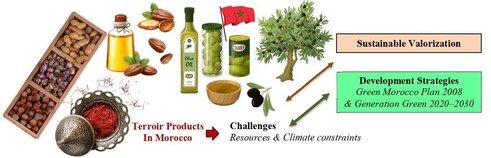
Moroccan terroir products represent a significant wealth, stemming from the country’s biological diversity, local production conditions, and the traditional knowledge of rural communities. These products play a key role in the economic and social development of rural areas. Yet, their valorization remains limited by several constraints, including the lack of suitable technologies, the weak structuring of value chains, and the impacts of climate change. This study comprehensively surveys scientific work on the valorization of Moroccan terroir products, with a focus on the contribution of biotechnology as a tool for improving quality, preservation, and sustainability. A systematic literature review was conducted following the PRISMA method, covering the period 2001-2025. The selected publications were analysed to identify the main sectors studied, the technological approaches used, and research trends, in order to ensure the sustainable valorization of Moroccan terroir products and support the development of rural areas.
Downloads
References
Sahel, W., El Abbassi, I., 2025, Structural change in Morocco: Rethinking industrial policies, Structural Change and Economic Dynamics 74, 412-426. https://doi.org/10.1016/j.strueco.2024.12.008
Lambarraa, F., Ihle, R., & Elyoubi, H., 2021, How Successful Is Origin Labeling in a Developing Country Context? Moroccan Consumers’ Preferences Toward Local Products, Sustainability 13, 8433, 1-2. https://doi.org/10.3390/su13158433
Achli S., Ongoma V., Epule T. E., Dhiba D., Salih W., Ousayd L. & Chehbouni A., 2025, Exploring the key drivers of crop yields in Morocco a systematic review, Frontier in Agronmy 7, 1515938. https://doi.org/10.3389/fagro.2025.1515938
Zine-dine, K., Alouane, S., & Nefzi, N., 2024. La valorisation durable des produits du terroir au Maroc : une locomotive pour le développement économique et territorial, International, Journal of Accounting, Finance, Auditing, Management and Economics 5(6), 276-290. https://doi.org/10.5281/zenodo.11801794
Harrak, H., Ibtissame, I., El Antari, A., Zantar, S., Noutfia, Y., Elfazazi, K., & Boujnah, M., 2024, Strengthening the climate resilience of local products through appropriate post-harvest valorization models, African and Mediterranean Agricultural Journal - Al Awamia 143, 319-333 https://doi.org/10.34874/IMIST.PRSM/afrimed-i143.49550
Klerkx, L., Jakku, E., & Labarthe, P., 2019, A review of social science on digital agriculture, smart farming and agriculture 4.0: New contributions and a future research agenda. NJAS: Wageningen Journal of Life Sciences 90-91(1), 1-16. https://doi.org/10.1016/j.njas.2019.100315
Elolu S., Byarugaba R., Opiyo A. M., Nakimbugwe D., Mithöfer D., & Huyskens-Keil S., 2023, Improving nutrition-sensitive value chains of African indigenous vegetables: current trends in postharvest management and processing, Frontier in Sustainable Food Systems 7, 118021. https://doi.org/10.3389/fsufs.2023.1118021
Segdoud, J., Outougane, E. H., Abdelkhalik, H., Azouaoui, H., 2024, Key Success Factors for Cooperatives Producing Local Produce: A Case Study of Cooperatives in the Souss-Massa and Drâa-Tafilalet Regions, (IJDAM) International Journal of Digitalization and Applied Managementz 1(1), 18-41. https://doi.org/10.23882/ijdam.24095
Wydra, S., 2019, Value Chains for Industrial Biotechnology in the Bioeconomy-Innovation System Analysis, Sustainability 11(8), 2435. https://doi.org/10.3390/su11082435
Usman, M., Nakagawa, M., & Cheng, S., 2023, Emerging Trends in Green Extraction Techniques for Bioactive Natural Products, Processes 11(12), 3444. https://doi.org/10.3390/pr11123444
Lemeilleur, S., & Sermage, J., 2020, Building a Knowledge Commons: Evidence from the Participatory Guarantee System for an Agroecology Label in Morocco. International Journal of the Commons 14(1), 465-480.https://doi.org/10.5334/ijc.1020
Hassine, Y., & Alhaderi, K., 2025, Territorial marketing and branding: A systematic literature review. International Journal of Research in Economics and Finance 2(7), 63-75. https://doi.org/10.71420/ijref.v2i7.151
Takubessi, M. I., Jalil B., & Heinrich M., 2025, The impact of climate change on medicinal plants and natural products: A scoping review, Frontier in Pharmacology 16, 1697581 https://doi.org/10.3389/fphar.2025.1697581
Martens, K., & Zscheischler, J., 2022, The Digital Transformation of the Agricultural Value Chain: Discourses on Opportunities, Challenges and Controversial Perspectives on Governance Approaches, Sustainability 14 (7), 3905. https://doi.org/10.3390/su14073905
Page, M. J.,2021, The PRISMA 2020 statement: an updated guideline for reporting systematic reviews, The BMJ 372: n71 http://dx.doi.org/10.1136/bmj.n71 (accessed 1 January 2026).
Krishnappa. M, Mariraj, S., & Puttesha C., 2022, Bibliometrics: An overview, International Advanced Research Journal in Science, Engineering and Technology (IARJSET) 9, 284-289 https://doi.org/10.17148/IARJSET.2022.9239
Food and Agriculture Organization of the United Nations (FAO), Report 2013, Introductory guide to quality linked to geographical origin and GI methodology, (Peter Damary and Emilie Vandecandelaere, Rome) https://www.fao.org/fileadmin/user_upload/foodquality/fichefiles/en/intro.pdf
Prévost., Lallemand, P.,2010, L’“ approche terroir ” : pour une démarche de recherche formation presented at ISDA Montpellier, 28/06 – 01/07 https://hal.science/hal-00512528v1
Housni, S., & Machrafi, M., 2024, Exploring Perceived Authenticity: A Review of Consumer Behavior Towards Terroir Products, Revue des Sciences Humaines et Sociales de l’Académie du Royaume du Maroc 3(1), 199-215. https://doi.org/10.34874/PRSM.shs-arm-vol3iss1.48430
Elgozmir, H., & Chouhbi, A.,2022, Produits terroirs : une grande histoire qui se prononce, Revue économie et kapital, 19, 2489-1282 https://doi.org/10.48395/IMIST.PRSM/rek-N19.29946
Idbendris, B., & Debbag, B.,2024, labellisation des produits du terroir et enjeux de développement territorial : analyse des contraintes dans le contexte marocain, REMSES 9, 2489-2068 https://doi.org/10.48375/IMIST.PRSM/remses-v9i1.40300
Tura, M., Gebeyew, K., Haki, G. D., & Tadesse, M.,2023, A selection of African traditional and emerging foods: processing, composition, nutritional, sensory and nutraceutical aspects, Current Research in Food Science 11, 2665-9271 https://doi.org/10.1016/j.crfs.2025.101112.
Omari, S., 2016, Etude du comportement des consommateurs vis-à-vis des produits du terroir: Cas des produits d’argane, Stratégie de Marque, Fidélisation et Comportement du Consommateur 3, 2028-5175. https://doi.org/10.48376/IMIST.PRSM/remarem-v3i15.7236
Food and Agriculture Organization of the United Nations (FAO), 2010, A guide for promoting quality linked to geographical origin, Linking people, places and products, (Emilie Vandecandelaere Filippo Arfini, Giovanni Belletti, Andrea Marescotti, Rome, FAO) http://www.fao.org/docrep/013/i1760e/i1760e00.pdf
Hamimaz, R., Tekelioglu ., Ilbert H. (ed.), & Tozanli S., 2009, Le développement des produits du terroir au Maroc : quelques préalables. Les produits de terroir, les indications géographiques et le développement local durable des pays méditerranéens, presented at CIHEAM, 2009, Options Méditerranéennes : Série A. Séminaires Méditerranéens, Montpellier, http://om.ciheam.org/om/pdf/a89/00801096.pdf
Hammou, D., &El Fadi, L., 2024, Les produits du terroir : Facteur de développement et de croissance des territoires, African Scientific Journal 03, 0810-0809. https://doi.org/10.5281/zenodo.11185916
European Training Foundation (ETF), 2021, Report on A case study of the agri-food sector in Morocco, (European Training Foundation).https://www.etf.europa.eu/sites/default/files/2021-04/future_of_skills_agri-food_sector_in_morocco.pdf
Moncada, B., Izquierdo, G. D., Rivera, J., Villamar, J., & Gimeno, R. M, 2025, Geographical Indication Labels for Food Products: A Literature Review, Encyclopedia 5(3), 115. https://doi.org/10.3390/encyclopedia5030115
Law No. 25-06 on the Distinctive Signs of Origin and Quality of Foodstuffs and Agricultural and Fishery Products (promulgated by Dahir No. 1-08-56 of 17 Joumada I 1429 (May 23, 2008)), Morocco. Official Gazette No. 5640, June 19, 2008. https://www.onssa.gov.ma/wp-content/uploads/Reglementation/R%C3%A9glementation%20Connexe/Signes%20Distinctifs%20d'Origine%20et%20de%20Qualit%C3%A9/LOI.25-06.FR.c1.pdf
El Fadili, M., 2012, L’élevage caprin acquis de recherche, stratégie et perspectives de développement, presented at Proceedings of the 1st Research Days on Ruminants, Institut National de la Recherche Agronomique (INRA), Rabat, Maroc. https://fr.scribd.com/document/727702067/caprinactes12175182-pdf-crdownload
Benhsain, W., 2021, Evaluation de l’impact du label collectif « terroir du Maroc » sur le processus de décision des consommateurs marocains, Moroccan journal of business studies, Available online at : https://www.emaa.ma/mjbs/articles/pdfs/vol2issu2/Evaluation%20del%27impact%20du%20label%20terroir%20du%20Maroc%20sur%20le%20processus%20de%20de%CC%81cision%20desconsommateurs%20marocains%20Wafaa%20BENHSAIN-2.pdf).
Agence pour le Développement Agricole, 2016, L’ADA lance un label collectif “Terroir du Maroc” (communication institutionnelle), Rabat, Maroc : Agence pour le Développement Agricole. https://ada.dardev.ma/sites/default/files/Fichier_Lien_Communiques20151228103013.pdf
Ministère de l’Agriculture, de la Pêche Maritime, du Développement Rural et des Eaux et Forêts. (2018). Stratégie de valorisation des produits du terroir et cadre légal des SDOQ. (accessed on 22 Februrary 2026)
https://www.origin-gi.com/wp-content/uploads/2018/02/Ministere_Agriculture.pdf
Ratib, A., & Ouahi, L., 2025, les Indications Géographiques au Maroc : Défis de mise en œuvre et perspectives pour la valorization des produits locaux. International Journal of Accounting, Finance, Auditing, Management and Economics 6(9), 447-461. https://ijafame.org/index.php/ijafame/article/view/2055
Ibourk, A., & El Aynaoui, K., 2023, Agricultural Cooperatives’ Sustainability and the Relevance of Start-Up Support Programs: Evidence from Cooperatives’ Level in Morocco, Sustainability 15(4), 3460. https://doi.org/10.3390/su15043460
Belil, S., Chebak, A., & Atwani, R, 2025, Vers un accompagnement technique structuré des coopératives au Maroc : diagnostic stratégique et évaluation intégrée des besoins pour des chaînes de valeur performantes. International Journal of Accounting, Finance, Auditing, Management and Economics 6(11), 43-63 https://ijafame.org/index.php/ijafame/article/view/2117
Agence pour le Développement Agricole (ADA), Promotion des produits du terroir et des labels, Ministère de l’Agriculture, du Développement Rural et des Eaux et Forêts, Royaume du Maroc. https://www.ada.gov.ma/fr/promotion-des-produits-du-terroir-et-des-labels(accessed on 20 December 2025)
Goodwin, S., 2025, The Role of Biotechnology in Modern Medicine and Agriculture, Global Journal of Biology, Agriculture & Health Sciences 14, 239. DOI: 10.35248/2319- 5584.25.14.239
Canda, M. L., 2025, Biotechnology in Agriculture, Medicine, and the Environment: A Review of Its Tools and Contributions, Technology et Biotechnology 3(2), 86–103 https://doi.org/10.53623/tebt.v3i2.721
Debich M., & Bill T., 2022, Biotechnology and stem cell technology overview, Applied Biotechnoly & Bioengieneering 9(2), 57-60. https://doi.org/10.15406/jabb.2022.09.00285
Khan, F.A., 2020, Biotechnology Fundamentals Third Edition (1st ed.), (CRC Press), pp 520 https://doi.org/10.1201/9781003024750
Organisation for Economic Co-operation and Development (OECD), 2011, Future Prospects for Industrial Biotechnology, (OECD Publishing). http://dx.doi.org/10.1787/9789264126633-en
Munis, D., Prakash, S., Lal, R., & Martin, D., 2019, "Future Biotechnology", The Euro Biotech Journal 3, 53-56. https://doi.org/10.2478/ebtj-2019-0006
Han, P., Lu, Q., Fan, L., & Zhou, W., 2019, A Review on the Use of Microalgae for Sustainable Aquaculture. Applied Sciences 9 (11), 2377. https://doi.org/10.3390/app9112377
Adepoju, F., Ivantsova, M., & Kanwugu, O. N., 2019, Gray biotechnology: An overview, presented at he VI International Young Researchers’ Conference 20-23 May, Ekaterinburg, Russia. https://doi.org/10.1063/1.5134350
Megavitry, R., Pahrijal, & Novitasari, S. A., 2024, Innovation in Traditional Food Processing Technology to Enhance Competitiveness of Local Products in the Global Market, West Science Agro 2 (04), 232-237. https://doi.org/10.58812/wsa.v2i04.1454
Amissah J.G.N., Adjei M..Y.B, Amissah J.N., Asem F.E. & Kolog JD, 2025, Processing, preservation, and value addition of indigenous food crops in West Africa. Frontiers in Sustainable Food Systems, 9, 1657056 https://doi.org/10.3389/fsufs.2025.1657056
Gharby, S., Charrouf, Z., 2022, Argan Oil: Chemical Composition, Extraction Process, and Quality Control, Frontier in Nutrition, 8, 804587 doi.org/10.3389/fnut.2021.804587
Chemat ,F., Abert VIAN, M., Fabiano-tixier , AS., Nutrizio , M., Jambrak ,A., Munekata , P., Lorenzo ,J.Barba ,F., Arianna Binello , B., Cravotto, G., 2020, A review of sustainable and intensified techniques for extraction of food and natural products, Green Chemistry, 22, 2325-2353 DOI: https://doi.org/10.1039/C9GC03878G
Belletti, G., burgassi, T., manco, E., Marescotti, A., PaccianI A., Scaramuzzi S., 2007, The roles of geographical indications (PDO and PGI) on the internationalisation process of agro-food products, Presented at the 105th EAAE Seminar ‘International Marketing and International Trade of Quality Food Products, Bologna, Italy, March 8-10. https://doi.org/10.22004/ag.econ.7851
Megavitry, R., Pahrijal, R., Novitasari, S. A., 2024, Innovation in traditional food processing technology to enhance competitiveness of local products in the global market, West Science Agro 2(04), 232–237. https://doi.org/10.58812/wsa.v3i04
Yuan, Y., Wei, X., Mao, Y., Zheng, Y., He, N., Guo, Y., Wu, M., Dumpler, J.,Li, B., Chen, X., Cai, X., Wu, J., Tian, Y.,Xie, S., Subbiah, J., Wang, S., 2025, Innovative Food Processing Technologies Promoting Efficient Utilization of Nutrients in Staple Food Crops, Engineering 50, 229-244. https://doi.org/10.1016/j.eng.2025.04.014
Amamou, A., Chabouh, S., Sidhom, L., Zouari, A., Mami, A, 2025, Agri-Food Supply Chain Sustainability Indicators from a Multi-Capital Perspective: A Systematic Review, Sustainability 17(9), 4174 https://doi.org/10.3390/su17094174
Jyoti P., KoichI, W., Wilhelm H., 2016, Review: Diversity of Microorganisms in Global Fermented Foods and Beverages, Frontiers in Microbiology 7, 377. https://doi.org/10.3389/fmicb.2016.00377
Ansabayeva, A., Makhambetov, M., Rebouh, N. Y., Abdelkader, M., Saudy, H. S., Hassan, K. M., Nasser, M. A., Ali, M. A. A., Ebrahim, M., 2025, Plant Growth-Promoting Microbes for Resilient Farming Systems: Mitigating Environmental Stressors and Boosting Crops Productivity A Review, Horticulturae 11(3), 260. https://doi.org/10.3390/horticulturae11030260
Aguirre-Garcia, Y. L., Nery-flores, S. D., Campos-muzquiz, L. G., Flores-gallegos, A. C., Palomo-ligas, L., Ascacio-valdes, J. A., Sepulveda-Torres, L., Rodriguez-Herrera, R., 2024,. Lactic Acid Fermentation in the Food Industry and Bio-Preservation of Food. Fermentation 10 (3), 168. https://doi.org/10.3390/fermentation10030168
Ossowska, L., Janiszewska, D., BEBA, P., Wojcieszak-Zbierska, M. M., Kwiatkowski, G.,2025, The Contribution of Regional Products to Short Agri-Food Supply Chains, Sustainability 17 (24), 10934. https://doi.org/10.3390/su172410934
Sarkhel, S., Kaur, S., Das, R., Sharma, A., Kheto, A., Saha, D., Kumar, Y., 2025, Antimicrobial active packaging with biopolymers and natural extracts: sustainable solutions and technological challenges, Sustainable Food Technology. https://doi.org/10.1039/D5FB00689A
E., Bouis, H., E., Saltzman,A., 2016, Improving nutrition through biofortification: A review of evidence from HarvestPlus, Global Food Security 12 49-58. https://doi.org/10.1016/j.gfs.2017.01.009.
Christian, M., Obi, A., Zantsi, S., Mdoda, L., Jiba, P. 2024, The Role of Cooperatives in Improving Smallholder Participation in Agri-Food Value Chains: A Case Study of One Local Municipality in Eastern Cape, South Africa. Sustainability 16 (6), 2241. https://doi.org/10.3390/su16062241
Food and Agriculture Organization of the United Nations (FAO), 2011, Science and technology offers great opportunities for rural women’s empowerment https://www.fao.org/gender/insights/insights-detail/Science-and-technology-offers-great-opportunities-for-rural-women-s-empowerment- (accessed on 20 December 2025)
Skallerud, K., H. Wien,A., H., 2019, Preference for local food as a matter of helping behaviour: Insights from Norway, Journal of Rural Studies 67, 79-88 https://doi.org/10.1016/j.jrurstud.2019.02.020.
Peron, G., Ferrarese, I., Carmo DosSantos, N., Rizzo, F., Gargari, G., Bertoli, N., Gobbi, E., Perosa, A., Selva, M., Dall’Acqua, S., 2024, Sustainable Extraction of Bioactive Compounds and Nutrients from Agri-Food Wastes: Potential Reutilization of Berry, Honey, and Chicory Byproducts, Applied Sciences, 14, 10785. https://doi.org/ 10.3390/app142310785
Downloads
Additional Files
Published
How to Cite
Issue
Section
License
Copyright (c) 2026 Barae Abaida, Rajaa Tesse, Bouchaib Bahlaouan, FatimaZahra Boutaleb, Marouane Chahbouni, Ghita Radi Benjelloun, Nadia Boutaleb

This work is licensed under a Creative Commons Attribution-NonCommercial 4.0 International License.
This work is licensed under a Creative Commons Attribution-NonCommercial 4.0 International License (CC BY-NC 4.0).
Readers may copy, distribute, and adapt the work for non-commercial purposes, provided the original author and source are credited.
For full licence details, please visit https://creativecommons.org/licenses/by-nc/4.0/.