Impact of storage temperature and duration on rRT-PCR Cycle Threshold (Ct) values in SARS-CoV-2-positive nasopharyngeal Samples: A study at a provincial hospital in Morocco
DOI:
https://doi.org/10.63095/NBSEH.26.338615Keywords:
SARS-CoV-2, RT-PCR, CT value, Storage temperature, Storage durationAbstract
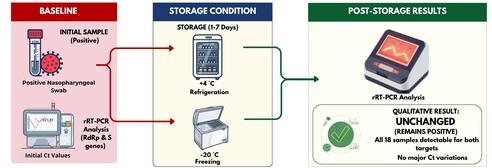
Reverse transcription polymerase chain reaction (RT-PCR) is the gold standard for SARS-CoV-2 diagnosis of infection. Pre-analytical factors such as storage temperature and duration may affect RNA stability and, consequently, RT-PCR performance. This study aimed to assess the impact of these factors on cycle threshold (Ct) values to ensure reliable diagnostic results. Eighteen SARS-CoV-2–positive nasopharyngeal swab samples were stored at +4 °C and −20 °C and analyzed by RT-PCR over a period of 1 to 7 days. Detection of the S (Spike) and RdRp (RNA-dependent RNA polymerase) genes was performed, and Ct values were compared before and after storage. All analyses were conducted using the same standardized protocol for RNA extraction, amplification, and result interpretation. All initially positive samples remained positive after storage. Ct values showed only minor variations, with mean decreases of −1.02 cycles for RdRp and −1.05 cycles for the S gene after storage. Variations of up to 2–3 Ct cycles were observed in some samples. These findings suggest that short-term storage under standard conditions is unlikely to affect SARS-CoV-2 detection by RT-PCR. Because of the limited sample size, the analysis was mainly descriptive. Therefore, short-term storage of SARS-CoV-2 samples under routine laboratory conditions did not alter RT-PCR qualitative results.
Downloads
References
Zhu, N., Zhang, D., Wang, W., Li, X., Yang, B., Song, J., Zhao, X., Huang, B., Shi, W., Lu, R., Niu, P., Zhan, F., Ma, X., Wang, D., Xu, W., Wu, G., Gao, G.F., & Tan, W., 2020, A novel coronavirus from patients with pneumonia in China, 2019. New England Journal of Medicine 382(8), 727–733. https://doi.org/10.1056/NEJMoa2001017
Li, J., Lai, S., Gao, G.F., & Shi, W., 2021, The emergence, genomic diversity and global spread of SARS-CoV-2. Nature 600, 408–418. https://doi.org/10.1038/s41586-021-04188-6
Anagoni, S., Mudhigeti, N., Alladi, M., Anju, V., Am, P., & Kalawat, U., 2022, Effect of delay in processing and storage temperature on diagnosis of SARS-CoV-2 by RT-PCR testing. Indian Journal of Medical Microbiology 40(3), 427–432. https://doi.org/10.1016/j.ijmmb.2022.03.005
Wu, Z.G., Zheng, H.Y., Gu, J., Li, F., Lv, R.L., Deng, Y.Y., Xu, W.Z., & Tong, Y.Q., 2020, Effects of different temperature and time durations of virus inactivation on results of real-time fluorescence PCR testing of COVID-19 viruses. Current Medical Science 40(4), 614–617. https://doi.org/10.1007/s11596-020-2224-y
Basso, D., Aita, A., Navaglia, F., Franchin, E., Fioretto, P., Moz, S., Bozzato, D., Zambon, C.F., Martin, B., Dal Prà, C., Crisanti, A., & Plebani, M., 2020, SARS-CoV-2 RNA identification in nasopharyngeal swabs: issues in pre-analytics. Clinical Chemistry and Laboratory Medicine 58(9), 1579–1586. https://doi.org/10.1515/cclm-2020-0749
Li, H., Liu, D., Zhou, Q., Rodriguez, G.D., Pietz, H., Singh, V., Konadu, E., James, K.K., Lui, C., Shao, M., Chen, J., Schreiner, A., Urban, C., Truong, J., Prasad, N., & Rodgers, W.H., 2025, Comparative analysis of RT-PCR and a colloidal gold immunochromatographic assay for SARS-CoV-2 detection. Diagnostics 15(11), 1362. https://doi.org/10.3390/diagnostics15111362
Engelmann, I., Alidjinou, E.K., Ogiez, J., Pagneux, Q., Miloudi, S., Benhalima, I., Ouafi, M., Sane, F., Hober, D., Roussel, A., Cambillau, C., Devos, D., Boukherroub, R., & Szunerits, S., 2021, Preanalytical issues and cycle threshold values in SARS-CoV-2 real-time RT-PCR testing: should test results include these? ACS Omega 6(10), 6528–6536. https://doi.org/10.1021/acsomega.1c00166
Rao, S.N., Manissero, D., Steele, V.R., & Pareja, J., 2020, A systematic review of the clinical utility of cycle threshold values in the context of COVID-19. Infectious Diseases and Therapy 9(3), 573–586. https://doi.org/10.1007/s40121-020-00324-3
Nairz, M., Bellmann-Weiler, R., Ladstätter, M., et al., 2021, Overcoming limitations in the availability of swab systems used for SARS-CoV-2 laboratory diagnostics. Scientific Reports 11, 2261. https://doi.org/10.1038/s41598-021-81782-8
Alfaro-Núñez, A., Crone, S., Mortensen, S., Rosenstierne, M.W., Fomsgaard, A., Marving, E., Nielsen, S.H., Jørgensen, M.G.P., Polacek, C., Cohen, A.S., & Nielsen, C., 2022, SARS-CoV-2 RNA stability in dry swabs for longer storage and transport at different temperatures. Transboundary and Emerging Diseases 69(2), 189–194. https://doi.org/10.1111/tbed.14339
Rogers, A.A., Baumann, R.E., Borillo, G.A., Kagan, R.M., Batterman, H.J., Galdzicka, M.M., & Marlowe, E.M., 2020, Evaluation of transport media and specimen transport conditions for the detection of SARS-CoV-2 by real-time reverse transcription-PCR. Journal of Clinical Microbiology 58(8), e00708-20. https://doi.org/10.1128/JCM.00708-20
Mosscrop L, Watber P, Elliot P, Cooke G., Barclay W., Freemont P.S., Rosadas C., Taylor G.P., 2022, Evaluation of the impact of pre-analytical conditions on sample stability for the detection of SARS-CoV-2 RNA. Journal of Virological Methods.Nov;309:114607. https://doi.org/10.1016/j.jviromet.2022.114607
Beziér, C., Anthoine, G., & Charki, A., 2020, Reliability of RT-PCR tests to detect SARS-CoV-2: risk analysis. International Journal of Metrology and Quality Engineering 11, 15. https://doi.org/10.1051/ijmqe/2020013
Kim, N., Kwon, A., Roh, E.Y., Yoon, J.H., Han, M.S., Park, S.W., Park, H., & Shin, S., 2021, Effects of storage temperature and media/buffer for SARS-CoV-2 nucleic acid detection. American Journal of Clinical Pathology 155(2), 280–285. https://doi.org/10.1093/ajcp/aqaa207
Morais, O., Alves, M.R., Ramos, C., Ferreira, F., & Fernandes, P., 2022, The matrix effect in the RT-PCR detection of SARS-CoV-2 using saliva without RNA extraction. Diagnostics 12(7), 1547. https://doi.org/10.3390/diagnostics12071547
Downloads
Additional Files
Published
How to Cite
Issue
Section
License
Copyright (c) 2026 Oumaima Mallouk, Aicha Qasmaoui , Rachid Amgoun , Said Hilali , Samira Natoubi

This work is licensed under a Creative Commons Attribution-NonCommercial 4.0 International License.
This work is licensed under a Creative Commons Attribution-NonCommercial 4.0 International License (CC BY-NC 4.0).
Readers may copy, distribute, and adapt the work for non-commercial purposes, provided the original author and source are credited.
For full licence details, please visit https://creativecommons.org/licenses/by-nc/4.0/.