Addressing Water Scarcity using Repurposed Oil Carriers
DOI:
https://doi.org/10.63095/NBSEH.26.980326Keywords:
Water scarcity, Repurposed oil-carriers, Freshwater BackhaulingAbstract
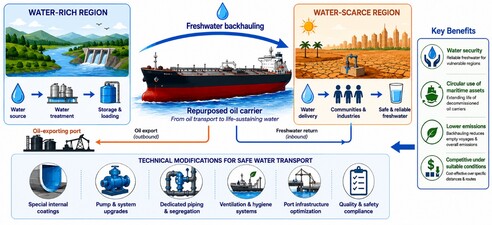
Freshwater scarcity causes social, economic, political, and environmental unrest. With unequal freshwater distribution globally, trading of freshwater can be a possible solution. But water trade, unlike oil trade, is not a recognized market. It would require a water trading fleet. Repurposed oil carriers as a scalable, flexible solution could be a first step. Engineering modifications, special internal coatings, environmental considerations, and port loading and unloading infrastructure optimization are examined. Cost-benefit analysis of capital expenditure and operational expenditure towards fuel, logistics, transportation, and maintenance are discussed. These are considered against known desalination costs to determine geographical and distance-based thresholds where maritime transport becomes competitive. By bridging gaps between decommissioned maritime assets and acute freshwater deficits, the study provides a comprehensive framework for policy makers, marine engineers, and economists to enhance freshwater resilience using the existing global shipping capacity.
Downloads
References
BBC News, 2018, The 11 Cities Most Likely to Run Out of Drinking Water. February 11. Available at https://www.bbc.com/news/world-42982959 (accessed 06 May 2026).
Damania, R., Desbureaux, S., Hyland, M., Islam, A., Moore, S., Rodella, A.-S., Russ, J., & Zaveri, E., 2017, Uncharted Waters: The New Economics of Water Scarcity and Variability. Washington, DC: World Bank. https://doi.org/10.1596/978-1-4648-1179-1
Rosa, L., & Sangiorgio, M., 2025, Global water gaps under future warming levels. Nature Communications 16(1), 1192. https://doi.org/10.1038/s41467-025-56517-2
UNESCO, 2016, The United Nations World Water Development Report 2016: Water and Jobs – Facts and Figures. Available at http://unesdoc.unesco.org/images/0024/002440/244041e.pdf (accessed 06 May 2026).
Magara, Y., 2002, Industrial water. In Kubota, S., & Tsuchiya, Y. (Eds.), Water Quality and Standards, Vol. I. Encyclopedia of Life Support Systems (EOLSS). ISBN: 978-1-84826-480-9.
King, R., 2025, The Water Footprints of Food and Agriculture Trade. Chatham House. Available at https://www.chathamhouse.org/2025/12/water-footprints-global-food-and-agriculture-trade (accessed 06 May 2026).
D'Odorico, P., Davis, K. F., Rosa, L., Carr, J. A., Chiarelli, D., Dell'Angelo, J., Gephart, J., MacDonald, G. K., Seekell, D. A., Suweis, S., & Rulli, M. C., 2018, The global food-energy-water nexus. Reviews of Geophysics 56(3), 456–531. https://doi.org/10.1029/2017RG000591
Amara, 2026, How Much Water Does AI Use? The Real Numbers for 2026. Tool Discovery. Available at https://www.aitooldiscovery.com/ai-infra/how-much-water-does-ai-use (accessed 06 May 2026).
UNEP, 2024, Ministerial Declaration of the United Nations Environment Assembly at Its Sixth Session. UNEP/EA.6/HLS.1. Available at https://docs.un.org/en/UNEP/EA.6/HLS.1 (accessed 06 May 2026).
Kishor, M. S., & Agarwala, N., 2019, Sustainable desalination technologies: Avenues for cooperation in the Indo-Pacific. Maritime Affairs 15(1), 78–92. https://doi.org/10.1080/09733159.2019.1628335
[Shkri, A., & Fard, M. S., 2022, A sustainable approach in water desalination with the integration of renewable energy sources: Environmental engineering challenges and perspectives. Environmental Advances 9, 100281. https://doi.org/10.1016/j.envadv.2022.100281
Eke, J., Yusuf, A., Giwa, A., & Sodiq, A., 2020, The global status of desalination: An assessment of current desalination technologies, plants and capacity. Desalination 495, 114633. https://doi.org/10.1016/j.desal.2020.114633
anagopoulos, A., & Haralambous, K.-J., 2020, Environmental impacts of desalination and brine treatment: Challenges and mitigation measures. Marine Pollution Bulletin 161(Part B), 111773. https://doi.org/10.1016/j.marpolbul.2020.111773
Zolghadr-Asli, B., McIntyre, N., Djordjevic, S., Farmani, R., Pagliero, L., Martínez-Alvarez, V., & Maestre-Valero, J. F., 2023, A review of limitations and potentials of desalination as a sustainable source of water. Environmental Science and Pollution Research 30(56), 118161–118174. https://doi.org/10.1007/s11356-023-30662-x
IDRA, 2025, IDRA Desalination and Water Reuse Handbook 2025–2026. Global Water Intelligence. Available at https://www.globalwaterintel.com/documents/idra-desalination-and-reuse-handbook-2025-2026 (accessed 06 May 2026).
Condron, A., 2023, Towing icebergs to arid regions to reduce water scarcity. Scientific Reports 13(1), 365. https://doi.org/10.1038/s41598-022-26952-y
Koncagül, E., Tran, M., & Connor, R., 2021, The United Nations World Water Development Report 2021: Valuing Water – Facts and Figures. UNESCO World Water Assessment Programme, SC-2021/WS/3. Available at https://unesdoc.unesco.org/ark:/48223/pf0000375751 (accessed 06 May 2026).
Constantine, K., Massoud, M., Alameddine, I., & El-Fadel, M., 2017, The role of the water tankers market in water-stressed semi-arid urban areas: Implications on water quality and economic burden. Journal of Environmental Management 188, 85–94. https://doi.org/10.1016/j.jenvman.2016.11.065
Siddiqui, A. W., & Basu, R., 2021, Disentangling the relationship between oil demand and tanker charter rates using frequency-decomposed components. Research in Transportation Business & Management 41, 100623. https://doi.org/10.1016/j.rtbm.2021.100623
Al-Damkhi, A. M., Al-Fares, R. A., Al-Khalifa, K. A., & Abdul-Wahab, S. A., 2009, Water issues in Kuwait: A future sustainable vision. International Journal of Environmental Studies 66(5), 619–636. https://doi.org/10.1080/00207230903097552
Wang, C. M., & Tay, Z. Y., 2011, Very large floating structures: Applications, research and development. Procedia Engineering 14, 62–72. https://doi.org/10.1016/j.proeng.2011.07.007
Gray, R., 2019, How to Rehabilitate Old Oil Supertankers. BBC Future. July 1. Available at https://www.bbc.com/future/article/20190627-turning-oil-supertankers-into-green-power-stations (accessed 06 May 2026).
Environor, n.d., Company Profile. Available at https://thehub.io/startups/environor (accessed 06 May 2026).
ReliefWeb, 2014, Converted Oil Tankers Providing Fresh Water. Press release, March 5. Available at https://reliefweb.int/report/world/converted-oil-tankers-providing-fresh-water
Star of Hope USA, n.d., Official Website. Available at http://www.starofhopeusa.org/
Priscoli, J. D., & Wolf, A. T., 2009, Managing and Transforming Water Conflicts. New York: Cambridge University Press. ISBN 0521632161, 9780521632164.
Yavuz, H., 1997, The Manavgat Project of Turkey: Water, an Economic Good. International Journal of Water Resources Development 13(4), 561–566. https://doi.org/10.1080/07900629749638
Global Water Intelligence, 2005, Bulk transport: A solution to scarcity? Global Water Intelligence 6(12). Available at http://www.globalwaterintel.com/archive/6/12/general/bulk-transport-a-solution-to-scarcity.html (accessed 06 May 2026).
European Union (EU), 2012, REFRESH (Green Technology for Fresh Water Sea-Transportation Based on a Flexible Containers System). CORDIS. Available at https://cordis.europa.eu/project/id/262494/reporting (accessed 06 May 2026).
Sasaji, S., 1985, Research on the use of oil tanker's return space for transport of fresh water. Technical Bulletin of Nippon Kaiji Kyokai 3, 71–79. Available at https://dl.ndl.go.jp/pid/10577281 (accessed 06 May 2026).
Sharma, V., & Lande, P. B., 2010, Use of Oil Tanker Return/Ballast Space for the Transportation of Freshwater. Master Thesis, Norwegian University of Science and Technology, Trondheim. Available at https://hdl.handle.net/11250/237791 (accessed 06 May 2026).
Syzdlowski, A., & Szydlowski, I., 2011, Method and system for conveying water on oil tanker ships to deliver drinkable water to destinations. Patent WO2013016440A1. Available at https://patents.google.com/patent/WO2013016440A1/en (accessed 06 May 2026).
Maersk, 2024, Maersk Employees Innovate a System to Deliver Fresh Water from Maersk's Vessels to Ports. Press release, April 10. Available at https://www.maersk.com/news/articles/2024/04/10/maersk-employees-innovate-a-system-to-deliver-fresh-water-from-maersk-vessels-to-ports (accessed 06 May 2026).
Lazard, O., & Bin, S. A., 2026, Ecological Statecraft in the Midst of War: Water, Regeneration, and the Future of Gulf Security. Carnegie Endowment for International Peace. Available at https://carnegieendowment.org/research/2026/05/ecological-statecraft-in-the-midst-of-war-water-regeneration-and-the-future-of-gulf-security (accessed 06 May 2026).
Hodges, A., Hansen, K., & McLeod, D., 2014, The economics of bulk water transport in Southern California. Resources 3(4), 703–720. https://doi.org/10.3390/resources3040703
Bajaj, A., Singh, S. P., & Nayak, D., 2022, Impact of water markets on equity and efficiency in irrigation water use: A systematic review and meta-analysis. Agricultural Water Management 259, 107182. https://doi.org/10.1016/j.agwat.2021.107182
Santos, E., 2024, Beyond leakage: Non-revenue water loss and economic sustainability. Urban Science 8(4), 194. https://doi.org/10.3390/urbansci8040194
Dore, M. H. I., 2005, Exporting fresh water: Is there an economic rationale? Water Policy 7(3), 313–327. https://doi.org/10.2166/wp.2005.0020
Stojan, S., Dražić, D., Antonic, R., & Kulenovic, Z., 2011, Washing process of cargo tanks on tankers for transportation of crude oil. Available at https://www.geocities.ws/icts_papers/Papers/Stojan,%20Drazic,%20Antonic.pdf (accessed 06 May 2026).
Farooq, S., & Al-Layla, R. I., 1987, Study of water transportation to Saudi Arabia. Journal of Water Resources Planning and Management 113(3), 392–406. https://doi.org/10.1061/(ASCE)0733-9496(1987)113:3(392)
Costello, K. E., Lynch, S. A., McAllen, R., O'Riordan, R. M., & Culloty, S. C., 2022, Assessing the potential for invasive species introductions and secondary spread using vessel movements in maritime ports. Marine Pollution Bulletin 177, 113496. https://doi.org/10.1016/j.marpolbul.2022.113496
Ogunbiyi, O., Al-Rewaily, R., Saththasivam, J., Lawler, J., & Liu, Z., 2023, Oil spill management to prevent desalination plant shutdown from the perspectives of offshore cleanup, seawater intake and onshore pretreatment. Desalination 564, 116780. https://doi.org/10.1016/j.desal.2023.116780
Loshchenkov, V. V., & Knyazhev, V. V., 2021, Sea transport of fresh water. Journal of Physics: Conference Series 2096, 012167. https://doi.org/10.1088/1742-6596/2096/1/012167
Gebrael, K., Mitri, G., & Kalantzi, O.-I., 2024, Overview of nature-based solutions for climate resilience in the MENA region. Nature-Based Solutions 6, 100159. https://doi.org/10.1016/j.nbsj.2024.100159
Reiche, D., 2010, Energy policies of Gulf Cooperation Council (GCC) countries: Possibilities and limitations of ecological modernization in rentier states. Energy Policy 38(5), 2395–2403. https://doi.org/10.1016/j.enpol.2009.12.031
Gruen, G. E., 2007, Turkish water exports: A model for regional cooperation in the development of water resources. In: Shuval, H., & Dweik, H. (Eds.), Water Resources in the Middle East, Vol. 2. Springer, Berlin, Heidelberg. https://doi.org/10.1007/978-3-540-69509-7_15
Glied, V., & Kaciba, P., 2021, Water scarcity and water trade: Turkish attempts to supply a drying region. Acta Fakulty filozofické Západočeské univerzity v Plzni 1, 41–60. Available at http://hdl.handle.net/11025/44831 (accessed 06 May 2026).
Victor, R., Kotter, R., O'Brien, G., Mitropoulos, M., & Panayi, G., 2008, WHO guidelines for the safe use of wastewater, excreta and greywater, Volumes 1–4. International Journal of Environmental Studies 65(1), 157–176. https://doi.org/10.1080/00207230701846598
EMT Erimtan Müşavirlik Taahhüt Ticaret A.Ş., n.d., Manavgat River Water Supply Project. Available at http://www.emt-erimtan.com/project-32/manavgat-river-water-supply-project.html (accessed 06 May 2026).
Gürer, Ý., & Ülger, M., 2007, Manavgat River water: A limited alternative water resource for domestic use in the Middle East. In: Shuval, H., & Dweik, H. (Eds.), Water Resources in the Middle East, Vol. 2. Springer, Berlin, Heidelberg. https://doi.org/10.1007/978-3-540-69509-7_17
Bianchi, A., Belmondo, W., Wreyford, J. M., Gerdessen, J. C., Dykstra, J. E., & Rijnaarts, H. H. M., 2021, Treatment vs. transport: A framework for assessing the trade-offs between on-site desalination and off-site water sourcing for an industrial case study. Journal of Cleaner Production 285, 124901. https://doi.org/10.1016/j.jclepro.2020.124901
Usman, M., Sharma, D. D., & Ernst, M., 2025, Seawater and brackish water desalination. In: Bullerdiek, N., Neuling, U., & Kaltschmitt, M. (Eds.), Powerfuels. Green Energy and Technology. Springer, Cham. https://doi.org/10.1007/978-3-031-62411-7_8
Terra Daily, 2010, Turks Cancel Project to Sell Israel Water. July 17. Available at https://terradaily.com/turks-cancel-project-to-sell-israel-water-999/ (accessed 06 May 2026).
Jiang, W., & Marggraf, R., 2023, Can international freshwater trade contribute to SDG 6? Water 15(21), 3853. https://doi.org/10.3390/w15213853
Downloads
Additional Files
Published
How to Cite
Issue
Section
License
Copyright (c) 2026 Capt (Dr.) Nitin Agarwala

This work is licensed under a Creative Commons Attribution-NonCommercial 4.0 International License.
This work is licensed under a Creative Commons Attribution-NonCommercial 4.0 International License (CC BY-NC 4.0).
Readers may copy, distribute, and adapt the work for non-commercial purposes, provided the original author and source are credited.
For full licence details, please visit https://creativecommons.org/licenses/by-nc/4.0/.