The Role of Artificial Intelligence
DOI:
https://doi.org/10.63095/NBSEH.26.998182Keywords:
Artificial Intelligence (AI), Human Consciousness, EthicsAbstract
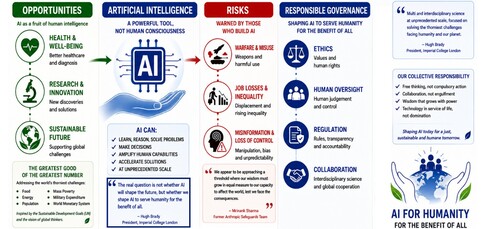
Artificial Intelligence, a product of human intelligence rather than its equivalent, offers remarkable opportunities but also raises serious concerns about its potential to escape control. Some researchers have warned of risks including manipulation, loss of privacy, technological unemployment, widening inequality, military applications and ethical failings. Others advocate collaboration to ensure that AI serves humanity. AI offers major benefits, particularly in medicine, where it improves diagnosis, accelerates treatment and expands opportunities for robotics and healthcare, but the existing data have limitations, and there are high costs and uncertain outcomes. Artificial General Intelligence can guarantee neither genuine intelligence nor authentic consciousness, and its pursuit could produce dangerous unpredictable behaviour, false justifications and consequences contrary to the common good. Human consciousness, through its freedom, uniqueness and unpredictability, remains superior to artificial intelligence. Only development guided by ethics, truth and the benefit of all can prevent AI from becoming a threat to humanity.
Downloads
References
Xu, Y., Liu, X., Cao, X., Huang, C., Liu, E., Qian, S., Liu, X., Wu, Y., Dong, F., Qiu, C.-W., Qiu, J., Hua, K., Su, W., Wu, J., Xu, H., Han, Y., Fu, C., Yin, Z., Liu, M., Roepman, R., Dietmann, S., Virta, M., Kengara, F., Zhang, Z., Zhang, L., Zhao, T., Dai, J., Yang, J., Lan, L., Luo, M., Liu, Z., An, T., Zhang, B., He, X., Cong, S., Liu, X., Zhang, W., Lewis, J. P., Tiedje, J. M., Wang, Q., An, Z., Wang, F., Zhang, L., Huang, T., Lu, C., Cai, Z., Wang, F., & Zhang, J., 2021, Artificial intelligence: A powerful paradigm for scientific research. The Innovation 2(4), Article 100179. https://doi.org/10.1016/j.xinn.2021.100179
Amodei, D., 2026(January), The adolescence of technology: Confronting and overcoming the risks of powerful AI. https://www.darioamodei.com/essay/the-adolescence-of-technolog
The Sunday Times, 2026 (February), The world is in peril: AI researchers quit with public warnings. https://www.thetimes.com/uk/technology-uk/article/ai-researchers-quit-openai-chatgpt-anthropic-pfhgpxztr
The Sunday Times, 2026(February), World is on AI path to disaster, former Google executive warns. https://www.thetimes.com/uk/technology-uk/article/ai-path-disaster-google-warning-v73709j57
Imperial College London, 2026 (Winter/Spring), Imperial: The magazine for the Imperial community (Issue 59). https://www.imperial.ac.uk/media/imperial-college/be-inspired/magazine/public/Imperial-59-web.pdf
Brett-Crowther, M., 2026, Water and the Future of the Middle East & North Africa (MENA). Natural Built Social Environment Health 2(3), 1–17. https://doi.org/10.63095/NBSEH.26.789210
Prorokova, T., 2019, Hyperobjects: philosophy and ecology after the end of the world. International Journal of Environmental Studies 76(3), 523–524. https://doi.org/10.1080/00207233.2018.1536436
Huxley, A., 1963, The Politics of Ecology: The Question of Survival (Santa Barbara: Center for the Study of Democratic Institutions).
Waddington, C. H., 1977, Tools for Thought (London: Jonathan Cape).
Waddington, C. H., 1978, The Man-Made Future (London: Croom Helm).
Booth, R., & Milmo, D., 2026 (March), Iran war heralds era of AI-powered bombing quicker than ‘speed of thought’. The Guardian. https://www.theguardian.com/technology/2026/mar/03/iran-war-heralds-era-of-ai-powered-bombing-quicker-than-speed-of-thought
Cohen, E. A., 1954, Human Behaviour in the Concentration Camp (London: Jonathan Cape).
Bartlett, S., 2025(June), Godfather of AI: They keep silencing me but I'm trying to warn them! [Video]. https://www.youtube.com/watch?v=giT0ytynSqg
Kaste, M., 2026, (April), Penalties stack up as AI spreads through the legal system. NPR. https://www.npr.org/2026/04/03/nx-s1-5761454/penalties-stack-up-ai-spreads-through-legal-system
Morrin, H., Nicholls, L., Levin, M., Yiend, J., Iyengar, U., DelGuidice, F., Bhattacharya, S., Tognin, S., MacCabe, J., Twumasi, R., Alderson-Day, B., & Pollak, T. A., 2026, Artificial intelligence-associated delusions and large language models: Risks, mechanisms of delusion co-creation, and safeguarding strategies. The Lancet Psychiatry 13(6), 522-530. https://doi.org/10.1016/S2215-0366(25)-00396-7
Downloads
Additional Files
Published
How to Cite
Issue
Section
License
Copyright (c) 2026 Michael Brett-Crowther

This work is licensed under a Creative Commons Attribution-NonCommercial 4.0 International License.
This work is licensed under a Creative Commons Attribution-NonCommercial 4.0 International License (CC BY-NC 4.0).
Readers may copy, distribute, and adapt the work for non-commercial purposes, provided the original author and source are credited.
For full licence details, please visit https://creativecommons.org/licenses/by-nc/4.0/.