Consequences of Sabotage of the Kakhovka Dam on the Waters of the Dnipro-Buh Estuary and the Black Sea
DOI:
https://doi.org/10.63095/NBSEH.25.877655Keywords:
Armed aggression, Estuarine pollution, Spot samples, Remote sensingAbstract
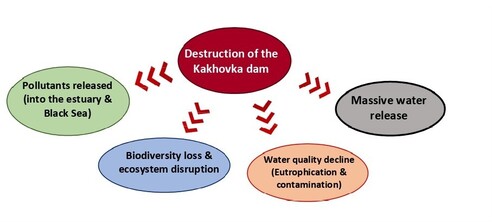
Sabotage of the Kakhovka dam released pollutants with concentrations up to 50 times their maximum permissible concentrations into 6,800 km2 of the Dnipro-Buh estuary and the Black Sea. The accumulation of biogenic elements doubled; there was a four-fold deterioration of physical and chemical properties, a three-fold increase in phytoplankton, and worsening of water quality to polytrophic status. The amplitude of freshwater flows to the estuary is now weakened and there is no effective mechanism to restore its status.
Downloads
References
Vyshnevskyi, V., Shevchuk, S., Komorinc, V., Oleynik, Y., & Gleick, P., 2023, The destruction of the Kakhovka dam and its consequences. Water International 48(5), 631-647. https://doi.org/10.1080/02508060.2023.2247679
Hartmane, I., Biyashev, B., Getman, A. P., Yaroshenko, O. M., & Anisimova, H. V., 2024, Impacts of war on Ukrainian nature. International Journal of Environmental Studies 81(1), 455-462. https://doi.org/10.1080/00207233.2024.2314856
Hapich, H., Novitskyi, R., Onopriienko, D., Dent, D., & Roubik, H., 2024, Water security consequences of the Russia-Ukraine war and the post-war outlook. Water Security 21, 100167. https://doi.org/10.1016/j.wasec.2024.100167
Pichura, V. I., Malchykova, D. S., Ukrainskij, P. A., Shakhman, I. A., & Bystriantseva, A. N., 2018, Anthropogenic transformation of hydrological regime of the Dnieper River. Indian Journal of Ecology 45 (3), 445-453.
Pichura, V., Potravka, L., Skrypchuk, P., Stratichuk, N., 2020, Anthropogenic and climatic causality of changes in the hydrological regime of the Dnieper River. Journal of Ecological Engineering 21(4), 1-10. https://doi.org/10.12911/22998993/119521
Kutishchev, P., Korzhov, Y., & Honcharova, O., 2022, Retrospective analysis and forecast of the main abiotic factors of the environmental conditions of ichthyofauna of the Dnipro-Buh estuary ecosystem. Topical Issues of the Development of Veterinary Medicine and Breeding Technologies, 476-792. https://doi.org/10.30525/978-9934-26-258-6-14
Kutishchev, P., Korzhov, Y., Honcharova, O., & Kozlov, L., 2021, Ecological assessment of water quality of the Dnieper-Buh estuary ecosystem according to hydrochemical indicators. Taurida Scientific Herald 120, 323-335. https://doi.org/10.32851/2226-0099.2021.120.41 (Ukrainian)
State Agency of Water Resources of Ukraine, 2021, Problems of the Ingulets River Basin. https://davr.gov.ua/fls18/presentatsiyaIngulets.pdf (Ukrainian)
Pichura, V., Potravka, L., Skok, S., & Vdovenko, N., 2020, Causal regularities of effect of urban systems on condition of hydroecosystem of Dnieper River. Indian Journal of Ecology 47 (2), 273-280.
Peppa, M., Vasilakos, C., & Kavroudakis, D., 2020, Eutrophication monitoring for Lake Pamvotis, Greece, using Sentinel-2 Data. ISPRS International Journal of Geo-Information 9(3), 143. https://doi.org/10.3390/ijgi9030143
Zhan, Y., Delegido, J., Erena, M., Soria, J. M., Ruiz-Verdú, A., Urrego, P., Sòria-Perpinyà, X., Vicente, E., & Moreno, J., 2022, Mar Menor lagoon (SE Spain) chlorophyll-a and turbidity estimation with Sentinel-2. Limnetica 41 (1). https://doi.org/10.23818/limn.41.18
Nurjaya, I.., Surbakti, H., & Natih, N., 2019, Model of total suspended solid (TSS) distribution due to coastal mining in Western Coast of Kundur Island part of Berhala Strait. Model of total suspended solids (TSS) distribution due to coastal mining in western coast of Kundur Island part of Berhala Strait. IOP Conference Series Earth and Environmental Science 278, 1-17. https://doi.org/10.1088/1755-1315/278/1/012056
Romanenko, V., Zhulynsjkyj, V., Oksijuk, O., & Yacyk, A., 1998, Methodology of ecological assessment of surface water quality by relevant categories. (Кyiv: Symvol-T, in Ukrainian)
Urasov, S., Kurjanova, S., & Urasov, M., 2009, Complex estimation of quality of waters on different methods and the ways of its perfection. Ukrainian Hydrometeorological Journal 5, 42-53 (Ukrainian)
Klymenko, M., Voznyuk, N., & Verbetska, K., 2012, Comparative analysis of surface-water quality standards. Scientific Reports of NULES of Ukraine 8, 1-15 (Ukrainian)
Gower, J., King, S., Borstad, G., & Brown, L., 2005, Detection of intense plankton blooms using the 709nm band of the MERIS imaging spectrometer. International Journal of Remote Sensing 26, 2005-2012.
Downloads
Additional Files
Published
How to Cite
Issue
Section
License
Copyright (c) 2025 Natural Built Social Environment Health

This work is licensed under a Creative Commons Attribution-NonCommercial 4.0 International License.
This work is licensed under a Creative Commons Attribution-NonCommercial 4.0 International License (CC BY-NC 4.0).
Readers may copy, distribute, and adapt the work for non-commercial purposes, provided the original author and source are credited.
For full licence details, please visit https://creativecommons.org/licenses/by-nc/4.0/.