A Comparative Study of the Physicochemical and Nutritional Properties of Moroccan Picholine Olives and Related Varieties: A Pathway to Development and Improvement
DOI:
https://doi.org/10.63095/NBSEH.25.490186Keywords:
Moroccan Picholine, Nutritional properties, Market differentiationAbstract
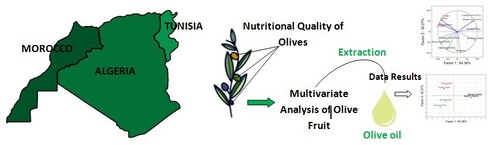
Understanding the quality of Moroccan Picholine olives is essential for both consumers and producers. This study investigates their physicochemical and nutritional properties, comparing them to neighbouring varieties: Tunisian Chemlali and Algerian Chemlal. Our analysis reveals that Moroccan Picholine olives have a significantly higher oleic acid content (68.47%), associated with cardiovascular health benefits, compared to lower levels in the other varieties. Additionally, they demonstrate superior oleuropein levels (167.81 mg/kg), a phenolic compound linked to antioxidant properties, while showing potential for increased hydroxytyrosol content. Quality assessments indicate moderate moisture content (53.66%) and acidity (0.29%), alongside a competitive oil yield (42.32%) and low peroxide value (4.37 meq/kg), suggesting good oil freshness. These findings highlight the nutritional advantages of Moroccan Picholine olives and propose strategies for enhancing cultivation and processing methods to elevate their quality and market position.
Downloads
References
Maesano, G., Chinnici, G., Giacomo, F., Bellia, C., Raimondo, M., & D’Amico, M., 2021, Economic and Environmental Sustainability of Olive Production: A Case Study. Agronomy 11(9), 1753. https://doi.org/10.3390/agronomy11091753
Ministère de l'Agriculture, de la Pêche Maritime, du Développement Rural et des Eaux et Forêts, 2020, Rapport sur la production oléicole au Maroc. Available online at https://www.agriculture.gov.ma/fr/filiere/olivier (Accessed on 12 September 2024).
Bouymajane, A., El Majdoub, Y.O., Cacciola, F., Russo, M., Salafia, F., Trozzi, A., Rhazi Filali, F., Dugo, P., & Mondello, L., 2020, Characterization of phenolic compounds, vitamin e and fatty acids from monovarietal virgin olive oils of “Picholinemarocaine” Cultivar. Molecules 25(22), 5428. https://doi.org/10.3390/molecules25225428
Ater M., Barbara H., & Kassout J., 2016, Importance des variétés locales, de l’oléastre et des pratiques traditionnelles de l’oléiculture dans la région de Chefchaouen (Nord du Maroc). In: Ater M., Essalouh L., Ilbert H., Moukhli A., Khadari B. (Eds), L’oléiculture au Maroc de la préhistoire à nos jours : pratiques, diversité, adaptation, usages, commerce et politiques (Montpellier : CIHEAM)
Food and Agriculture Organization (FAO), 2021, Olive oil production and market overview. Food and Agriculture Organization of the United Nations. Available online at https://www.fao.org/land-water/databases-and-software/crop-information/olive/es/ (Accessed on 12 September 2024).
Mendoza, J., & Gutiérrez, A., 2020, Nutritional Composition of Table Olives and Their Health Benefits. Food Chemistry 315, 126273. https://doi.org/10.1016/j.foodchem.2020.126273
Ben Abdallah, S., Suárez-Rey, E.M., Parra-López, C., & Elfkih, S., 2021, Evaluation of the environmental sustainability in the olive growing systems in Tunisia. Journal of Cleaner Production 282, 124526. https://doi.org/10.1016/j.jclepro.2020.124526
El Bakouri, A., Bouita, M., El Kharrim, K., Haboubi, K., Dimane, F., Tayebi, M., & Belghyti, D., 2024, Surface water quality measurements, wastewater and Olive Vegetation Waters (OVWs) impacts in Northern Morocco. International Journal of Environmental Studies 81(2), 675–692. https://doi.org/10.1080/00207233.2024.2322894
International Olive Council (IOC), 2020, Methods of analysis. International Olive Council. Available online at https://www.internationaloliveoil.org/what-we-do/chemistry-standardisation-unit/standards-and-methods/ (Accessed on 12 September 2024).
AOCS, 2017, Official Methods and Recommended Practices of the American Oil Chemists' Society. Available online at : https://library.aocs.org/ (Accessed on 14 September 2024).
Zhang, Z., Tong, Z., Shao, Y., Su, G., Li, K., & Li, C. (2024). Comparing and evaluating the oil composition of olive oil of 85 olive varieties in the Liangshan Region, China. Agronomy 14(2), 304. https://doi.org/10.3390/agronomy14020304
Mrabet, O., Asbai, Z., Hadidi, M., Bahlaouan, B., Tesse, R., El Antri, S., & Boutaleb, N. 2024, Fruit quality of ’Stanley’ plums based on soil composition across diverse agro-ecological zones of Morocco. Comunicata Scientiae 16, e4293. https://doi.org/10.14295/cs.v16.4293
Rashidinejad, A., & Ahmmed, M. K., 2024, The influence of ripening on the nutrient composition and antioxidant properties of New Zealand damson plums. Food Science & Nutrition 12(6), 4311–4320. https://doi.org/10.1002/fsn3.4097
Yu L. L., Davis W. C., Nuevo Ordonez Y., & Long S. E., 2013, Fast and accurate determination of K, Ca, and Mg in human serum by sector field ICP-MS. Analytical and Bioanalytical Chemistry 405 (27), 8761–8768. https://doi.org/10.1007/s00216-013-7320-4
Long, L., Gao, C., Qiu, J., Yang, L., Wei, H., & Zhou, Y., 2022, Fatty acids and nutritional components of the seed oil from Wangmo red ball Camellia oleifera grown in the low-heat valley of Guizhou, Scientific Reports 12(1), 16554. https://doi.org/10.1038/s41598-022-20576-y
Brand-Williams, W., Cuvelier, M.E., & Berset, C., 1995, Use of a free radical method to evaluate antioxidant activity. Lebensmittel-Wissenschaft&Technologie 28(1), 25–30. https://doi.org/10.1016/S0023-6438(95)80008
Prosky, L., Asp, N. G., Schweizer, T. F., DeVries, J. W., & Furda, I., 1988, Determination of insoluble and soluble dietary fiber in foods and food products: Collaborative study. Journal of the Association of Official Analytical Chemists 71(5), 1017–1023.
Mrabet, O., Bahlaouan, B., El Antri, S., & Boutaleb, N., 2024, Adaptation of grape cultivars to the semi-arid climate of Saïs: the case of Sultanine for sultana raisin production. International Journal of Environmental Studies 1–19. https://doi.org/10.1080/00207233.2024.2417625
Dabbou, S., Rjiba, I., Nakbi, A., Gazzah, N., Issaoui, M., Hammami, M., 2010, Compositional quality of virgin olive oils from cultivars introduced in Tunisian arid zones in comparison to Chemlali cultivars. Scientia Horticulturae 124(1), 122–127. https://doi.org/10.1016/j.scienta.2009.12.017
Bengana, M., Bakhouche, A., Lozano-Sánchez, J., Amir, Y., Youyou, A., Segura-Carretero, A., & Fernández-Gutiérrez, A., 2013, Influence of olive ripeness on chemical properties and phenolic composition of Chemlal extra-virgin olive oil. Food Research International 54(2), 1868–1875. https://doi.org/10.1016/j.foodres.2013.08.037
Saha, U., & Jackson, D., 2018, Analysis of moisture, oil, and fatty acid composition of olives by near-infrared spectroscopy: development and validation calibration models. Journal of the Science of Food and Agriculture 98(5), 1821–1831. https://doi.org/10.1002/jsfa.8658
Boussahel, S., Di Stefano, V., Muscarà, C., Cristani, M., & Melilli, M.G., 2020, Phenolic compounds characterization and antioxidant properties of monocultivar olive oils from Northeast Algeria. Agriculture 10, 494. https://doi.org/10.3390/agriculture10110494
BrkićBubola, K., Kolega, Š., Marcelić, Š., Šikić, Z., Gašparović-Pinto, A., Zorica, M., Klisović, D., Novoselić, A., JukićŠpika, M., & Kos, T.,2022, Effect of different watering regimes on olive oil quality and composition of Coratina Cultivar Olives Grown on Karst soil in Croatia. Foods 11(12), 1767. https://doi.org/10.3390/foods11121767
Jimenez-Lopez, C., Carpena, M., Lourenço-Lopes, C., Gallardo-Gomez, M., Lorenzo, J. M., Barba, F. J., Prieto, M. A., & Simal-Gandara, J., 2020, Bioactive compounds and quality of extra virgin olive oil. Foods 9(8), 1014. https://doi.org/10.3390/foods9081014
Ben Othman, N., Roblain D, Thonart., & Hamdi, M.,2008, Tunisian table olive phenolic compounds and their antioxidant capacity. Journal of Food Science 73(4), C235–40. https://doi.org/10.1111/j.1750-3841.2008.00711.x
Filoda, P. F., Chaves F. C., Hoffmann J. F., & Rombaldi C. V., 2021, Olive oil: a review on the identity and quality of olive oils produced in Brazil. RevistaBrasileira de Fruticultura 43(3). https://doi.org/10.1590/0100-29452021847
Schwingshackl, L., & Hoffmann, G., 2014, Monounsaturated fatty acids, olive oil and the risk of cardiovascular disease: a systematic review and meta-analysis. Nutrients 6(6): 3252–3270. https://doi.org/10.3390/nu6063252
Valls-Pedret, C., Sala-Vila, A., Serra-Mir, M., Corella, D., de la Torre, R., Martínez-González, M. Á., Martínez-Lapiscina, E. H., Fitó, M., Pérez-Heras, A., Salas-Salvadó, J., Estruch, R., & Ros, E., 2012, Mediterranean diet and age-related cognitive decline: a randomized clinical trial. JAMA Internal Medicine 172(3), 313–321. https://doi.org/10.1001/jamainternmed.2013.4946
Jimenez-Lopez, C., Carpena, M., Lourenço-Lopes, C., Gallardo-Gomez, M., Lorenzo J. M., Barba, F. J., Prieto, M. A., Simal-Gandara, J., 2020, Bioactive compounds and quality of extra virgin olive oil. Foods 9(8), 1014. https://doi.org/10.3390/foods9081014
Sacks, F. M., & Lichtenstein, A. H., 2001, Dietary fat and cardiovascular disease: a scientific statement from the American Heart Association. Circulation 104(20), 2595–2608. https://doi.org/10.1161/hc4601.098140
Siri-Tarino, P. W., Sun, Q., Hu, F. B., & Krauss, R. M., 2010, Meta-analysis of prospective cohort studies evaluating the association of saturated fat with cardiovascular disease. The American Journal of Clinical Nutrition 91(3), 535–546. https://doi.org/10.3945/ajcn.2009.27725
Visioli, F., & Galli, C., 2002, Biological properties of olive oil phytochemicals. Critical Reviews in Food Science and Nutrition 42(3), 209-221. https://doi.org/10.1080/10408690490463000
Kris-Etherton, P. M., & Innis, S., 2007, Dietary fat and cardiovascular disease: A presidential advisory from the American heart association. Circulation 115(3), 387–399. https://doi.org/10.1161/CIRCULATIONAHA.106.171644
Grundy, S.M., 1994, Influence of stearic acid on cholesterol metabolism relative to other long-chain fatty acids. American Journal of Clinical Nutrition 60(6), 986S–990S. https://doi.org/10.1093/ajcn/60.6.986S
Maffei Fascino, R., Galli C., 2005, Biological properties of olive oil. Critical Reviews in Food Science and Nutrition 45(5), 377–391. https://doi.org/10.1080/10408690490463000
Calder, P. C., 2011, Omega-3 fatty acids and inflammatory processes: from molecules to man. Biochemical Society Transactions 39(3), 1071–1076. https://doi.org/10.1042/BST20110663
Hu, F. B., & Willett, W. C., 2002, Optimal diets for prevention of coronary heart disease. JAMA 288(20), 2569–2578. https://doi.org/10.1001/jama.288.20.2569
Kalmijn, S., Launer, L. J., Ott, A., Witteman, J. C., Hofman, A., Breteler, M. M., 1997, Dietary fat intake and the risk of dementia in the Rotterdam Study. American Journal of Epidemiology 145(12), 1002–1009. https://doi.org/10.1093/oxfordjournals.aje.a009094
Bertelli, M., Kiani, A. K., Paolacci, S., Manara, E., Kurti, D., Dhuli, K., Bushati, V., Miertus, J., Pangallo, D., Baglivo, M., Beccari, T., Michelini, S., 2020, Hydroxytyrosol: A natural compound with promising pharmacological activities. Journal of Biotechnology 309, 29–33. https://doi.org/10.1016/j.jbiotec.2019.12.016
Tuck, K. L., & Hayball, P. J., 2002, Bioavailability of phenolic compounds: a review. Journal of Nutritional Biochemistry 13(7), 362–367. https://doi.org/10.1016/S0955-2863(02)00136-1
Sofi, F., Abbate, R., Gensini, G.F., & Casini, A., 2010, Accruing evidence on benefits of adherence to the Mediterranean diet on health: an updated systematic review and meta-analysis. American Journal of Clinical Nutrition 92(5), 1189–1196. https://doi.org/10.3945/ajcn.2010.29673
Cicerale, S., Conlan, X.A., Sinclair, A.J., & Keast, R.S., 2009, Chemistry and health of olive oil phenolics. Critical Reviews in Food Science and Nutrition 49(3), 218–236. https://doi.org/10.1080/10408390701856223
Servili, M., & Montedoro. G. F., 2002, Contribution of phenolic compounds to virgin olive oil. European Journal of Lipid Science and Technology 104, 9–10. https://doi.org/10.1002/1438-9312(200210)104:9/10%3c602
Paterakis, N., & Drosinos, E. H., 2009, Effect of irrigation on quality attributes of olive oil. Journal of Agricultural and Food Chemistry 57(15), 7048–7055. https://doi.org/10.1021/jf900862w
Gharby, S., 2022, Olive oil: extraction technology, chemical composition, and enrichment using natural additives. In: T. Yonar (Ed.), Olive Cultivation (London: IntechOpen).
Trajkovska-Petkoska, A., & Trajkovska-Broach, A., 2021, Health benefits of extra virgin olive oil, olive oil - new perspectives and applications (London: IntechOpen).
Alamprese., C, Caponio., F, & Chiavaro., E., 2021, Sustainability of the olive oil System, Foods 10(8), 1730. https://doi.org/10.3390/foods10081730
Marx, Í. M. G., 2023, Co-Extraction technique improves functional capacity and health-related benefits of olive oils: a mini review. Foods 12(8), 1667. https://doi.org/10.3390/foods12081667
Ciafardini, G., & Zullo, B. A., 2022, Microbiological and enzymatic activity modulates the bitter taste reduction in decanted Coratina Olive oil. Foods 11(6), 867. https://doi.org/10.3390/foods11060867
Jean, B. A., & Marie, B. C., 2014, Genetic and environmental features for oil composition in olive varieties. Oilseeds and fats, Crops and Lipids 21(5). https://doi.org/10.1051/ocl/2014007
Pittarello, M., Dattola, A., Gullo, G., Badagliacca, G., Monti, M., & Gelsomino, A., 2024, Olive tree physiology and productivity responses under no-tillage or digestate amendment in an acid clay soil. Soil Systems 8(1), 13. https://doi.org/10.3390/soilsystems8010013
Downloads
Additional Files
Published
How to Cite
Issue
Section
License
Copyright (c) 2025 Natural Built Social Environment Health

This work is licensed under a Creative Commons Attribution-NonCommercial 4.0 International License.
This work is licensed under a Creative Commons Attribution-NonCommercial 4.0 International License (CC BY-NC 4.0).
Readers may copy, distribute, and adapt the work for non-commercial purposes, provided the original author and source are credited.
For full licence details, please visit https://creativecommons.org/licenses/by-nc/4.0/.