A Clinical Note on Epidemiological Profile of Infected Diabetic Foot Patients on the Surgical Department of Al Farabi Regional Hospital of Oujda (NE-Morocco)
DOI:
https://doi.org/10.63095/NBSEH.25.882237Keywords:
Diabetic foot, Foot lesionsAbstract
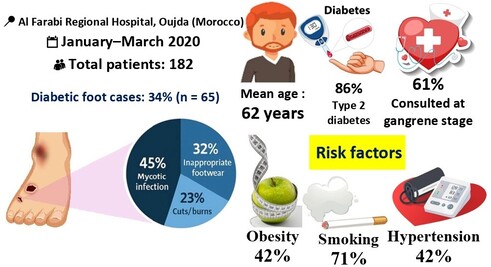
Diabetic foot is one of the most serious complications of diabetes, often leading to amputation or even death. This descriptive cross-sectional study aimed to analyse the epidemiological and clinical features of diabetic foot among patients hospitalized in the surgery department at Regional Hospital Centre (CHR) Al Farabi, Oujda, between January and March 2020. Among 182 patients hospitalized, 34% (n= 65) had diabetic foot lesions, mostly among type 2 diabetics (86%). The mean age was 62.1 ± 7.7 years, with an average diabetes duration of 13.7 years. Major risk factors included hypertension (42%) p<0.0001, smoking (71%)P<0.0012, and obesity (42%) p<0.001. Mycotic infection was the primary cause of the foot lesion (n = 29; 44.61%) p<0.001, followed by wearing inappropriate footwear (n = 21; 32.30%) p<0.003 and cuts and burns that were not felt (n = 15; 23.07%) p<0.004. In 61.53% of cases, the patient consults at the gangrene stage. Other lesions found include phlegmon 3%, ischaemic ulcer 4%, pyodermatitis 8%, poor plantar perforation 11%, and ischaemic necrosis 12.5 %. Only 40% of patients had knowledge of diabetic foot prevention despite attending education sessions. These findings underscore the urgent need for improved diabetic education and early intervention strategies.
Downloads
References
Gouta, E.L., Khalfallah, M., Dougaz,W., Samaali, I., Nouira, R., Bouasker, I., & Chadli Dziri, C., 2018, Morbidity and mortality of infected diabetic foot managed in general surgical department. La Tunisie Medicale 96 (12), 875-883.PMID : 31131868. ISSN :0041-4131.
Martini, J., & Senneville, E., 2018 January 11–12, The diabetic foot. Presented at the National Days of the DES France. In Endocrinology-Diabetes and Metabolic Diseases. MCED N°92, 96-101 .ISSN : 1639-6685
Boulton, A., Armstrong, D., Krisner, R., Attinger, C., Lavery, L., Lipsky, B., Mills, J., & Steinberg, J., 2018, Diagnosis and management of diabetic foot complications. ADA Clinical Compendia 2018(2), pp. 1–20. https://doi.org/10.2337/db20182-1
Dalibon, P., 2018, Le pied diabétique infecté. Actualités Pharmaceutiques 57(581), 42–45. https://doi.org/10.1016/j.actpha.2018.10.009
Marre, M., Dhatariya, K., Stephen, C., Richard, E., Pratley, J.B ., Buse, J., & Simpson, R., 2018, Presented at the Francophone Society of Endocrinology, Nancy, France, September 12–15.
Bernatchez, J., Mayo, A., & Kayssi, A., 2021, The epidemiology of lower extremity amputations, strategies for amputation prevention, and the importance of patient-centered care. Seminars in Vascular Surgery 34(1), 54–58. https://doi.org/10.1053/j.semvascsurg.2021.02.011
Van, G. H., 2014, Le pied diabétique. Revue Du Rhumatisme Monographies 81(3), 192–197. https://doi.org/10.1016/j.monrhu.2014.04.007
Sow, D., Traore, D., Konaté, M., Sidibé, O., Mariko, M., Sy, D., Traoré, B, Dao, K, Koné, A, & Doumbia, N, 2019, Aspects Cliniques et Paracliniques des Amputations du Pied Diabétique au Mali. Health Sciences and Disease 20(5). https://doi.org/10.5281/hsd.v20i5.1569
Hammoudi, J., Dahmani, H., Bouanani, N.H., Nouayti, H., Mekhfi, H., Legssyer, A., Bnouham, M., & Ziyyat, A., 2018, Risk Factors and Diabetes Related Complications Frequency in the Population of the Northeastern Morocco. Open Journal of Epidemiology 8(03), 164-185. https://doi.org/10.4236/ojepi.2018.83014
Mharchi, S., & Maamri, A., 2022, Prevalence and risk factors for diabetic complications: 8-year retrospective report from a single regional diabetes center to the eastern region of Morocco. Medicina Moderna - Modern Medicine 29(1), 75-87. https://doi.org/10.31689/rmm.2021.29.1.75
Mharchi, S., & Maamri, A., 2024, Diet, Physical Activity, and Their Impact on Chronic Diseases (Hypertension and T2DM) among North-Eastern Morocco’s Population. Medicina Moderna - Modern Medicine 31(1), 37–48. https://doi.org/10.31689/rmm.2024.31.1.37
Djibril, A. M., Mossi, E. K., Djagadou, A. K., Balaka, A., Tchamdja, T., & Moukaila, R., 2018, Pied diabétique: aspects épidémiologique, diagnostique, thérapeutique et évolutif à la Clinique Médico-chirurgicale du CHU Sylvanus Olympio de Lomé. Pan African Medical Journal 30(1). https://doi.org/10.11604/pamj.2018.30.4.14765
Stancu, B., Ilyés, T., Farcas, M., Coman, H. F., Chiș, B. A., & Andercou, O. A., 2022, Diabetic foot complications: A Retrospective cohort study. International Journal of Environmental Research and Public Health 20(1), 187. https://doi.org/10.3390/ijerph20010187
Elazizi, L., Lazar, N., Mohib, A., Aynaou, H., Salhi, H., & Ouahabi, H. E., 2021, Pied diabétique : aspects épidémiologique, diagnostique, thérapeutique et évolutif. Annales d’ Endocrinologie 82(5), 492. https://doi.org/10.1016/j.ando.2021.08.698
Laidi, S., El Aziz, S., & Chadli, A., 2016, Management of the infected diabetic foot at the Ibn Rochd University Hospital in Casablanca: 244 cases. Annales d’Endocrinologie P635 77(4), 516. https://doi.org/10.1016/j.ando.2016.07.805
Aynaou, H., & Latrech, H., 2019, Neuropathie diabétique périphérique au CHU Mohamed VI d’Oujda. IOSR Journal of Dental and Medical Sciences 18(8),64-68. https://doi.org/10.9790/0853-1808056468
Ouchene, C., 2023, Pied diabétique, aspects épidémiologiques, diagnostiques, et thérapeutiques à l’EPH de Sour Elghozlan Bouira. Avicenna Medical Research 2(3), 107-112. https://doi.org/10.34118/amr.v2i3.3527
Quassimi, F., 2015, Pied diabétique: expérience du service de dermatologie à l'hôpital militaire Moulay Ismail de Meknes (à propos de 49 cas). Thesis, Fès, Morocco.
Talbi, N., & Boumaza, K., 2021, Contribution à la caractérisation de la microflore impliquée dans l’infection du pied diabétique et prévalence de cette pathologie dans l’Ouest Algérien. Master dissertation, Algeria. Available online at: https://dspace.univ-sba.dz/handle/123456789/1906 (accessed 21 June 2025).
Chaker, F., Khessairi, N., Yazidi, M., Oueslati, I., & Chihaoui, M.,2022, Risk factors for major lower limb amputations in diabetic patients hospitalized for diabetic foot ulcer. La Tunisie Medicale 100(11), 769-773. PMID: 37551518. http://europepmc.org/abstract/MED/37551518
Mutyambizi, C., Pavlova, M., Chola, L., Hongoro, C., & Groot, W., 2018, Cost of diabetes mellitus in Africa: a systematic review of existing literature. Global Health 14, 3. https://doi.org/10.1186/s12992-017-0318-5
Downloads
Additional Files
Published
How to Cite
Issue
Section
License
Copyright (c) 2025 Saliha Mharchi, Maryam Slamini, Latifa Mechkirrou, Lamiaa Belasri, Mourad Arabi

This work is licensed under a Creative Commons Attribution-NonCommercial 4.0 International License.
This work is licensed under a Creative Commons Attribution-NonCommercial 4.0 International License (CC BY-NC 4.0).
Readers may copy, distribute, and adapt the work for non-commercial purposes, provided the original author and source are credited.
For full licence details, please visit https://creativecommons.org/licenses/by-nc/4.0/.