Impact of irrigation water sources on growth and physiological traits in tomato (Solanum lycopersicum)
DOI:
https://doi.org/10.63095/NBSEH.25.513288Keywords:
Solanum lycopersicum, Wastewater, Metabolic stress, IrrigationAbstract
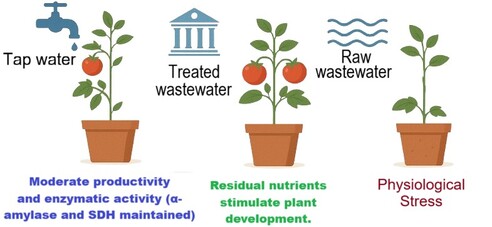
This study examined the effects of tap water (TW), treated wastewater (TWW), and raw wastewater (RWW) on Solanum lycopersicum. Raw wastewater showed high nitrite (42.57 ± 1.78 mg·L⁻¹) and BOD₅ (170 ± 12 mg·L⁻¹) levels. These values were lower in TWW (12.41 ± 0.56 mg·L⁻¹ and 20 ± 4.5 mg·L⁻¹), which met Moroccan irrigation standards. Germination tests revealed higher α-amylase activity and germination index in RWW. This may reflect nutrient enrichment. After 90 days, plants irrigated with TWW showed the strongest vegetative growth, with taller stems (57.5 cm) and larger leaves. Microbiological analysis of tomato fruits showed minimal contamination across treatments. Succinate dehydrogenase activity was highest in TW-irrigated plants. This indicated optimal mitochondrial function. TWW produced moderate reductions in activity. RWW caused marked declines in both leaves and fruits, suggesting metabolic inhibition under stress. These findings show that TWW provides a useful balance between nutrient supply and plant health, supporting its suitability for sustainable irrigation.
Downloads
References
He, C., Liu, Z., Wu, J., Pan, X., Fang, Z., Li, J., & Bryan, B. A., 2021, Future global urban water scarcity and potential solutions. Nature Communications 12(1), 4667. https://doi.org/10.1038/s41467-021-25026-3
FAO. 2017. The future of food and agriculture – Trends and challenges. Rome: Food and Agriculture Organization of the United Nations (Rome: FAO). Available at: https://openknowledge.fao.org/server/api/core/bitstreams/2e90c833-8e84-46f2-a675-ea2d7afa4e24/content
Claro, A., Fonseca, A., Fraga, H., & Santos, J., 2024, Future Agricultural Water Availability in Mediterranean Countries under Climate Change: A Systematic Review. Water 16(17), 2484. https://doi.org/10.3390/w16172484
Casablanca-Settat Regional Investment Center (RIC), 2018, Socioeconomic data of the Casablanca-Settat Region. https://www.hcp.ma/Les-comptes-regionaux-de-l-annee-2018_a2585.html
Et-Touile, H., 2023, Water Scarcity Impacts On Food Production in Morocco. International Journal of Strategic Management and Economic Studies 2(5), 1640–1653. https://doi.org/10.5281/zenodo.8355193
Ungureanu, N., Vlăduț, V., & Voicu, G., 2020, Water scarcity and wastewater reuse in crop irrigation. Sustainability 12(21), 9055. https://doi.org/10.3390/su12219055
Yadav P., Singh R.P., Gupta R.K., Pradhan T., Raj A., Singh S.K., Kaushalendra, Pandey K.D., Kumar A., 2023, Contamination of soil and food chain through wastewater application,
In: Luiz Fernando Romanholo Ferreira, Ajay Kumar, Muhammad Bilal (Eds)
Advances in Chemical Pollution, Environmental Management and Protection, Volume 9, 2023, pp. 109–132 (Amsterdam: Elsevier). DOI: https://doi.org/10.1016/bs.apmp.2022.11.001
Chakri, N., Amrani, B. E., & Berrada, F., 2021, Modeling and optimization of wastewater treatment, from the Ain Chock faculty in Morocco, using the vertical flow filter filled with pozzolana. Desalination and Water Treatment 234, 376–385. https://doi.org/10.5004/dwt.2021.27598
Peco, J., Pérez–López, D., Centeno, A., Moreno, M., Villena, J., & Moratiel, R., 2023, Comparison of physiological and biochemical responses of local and commercial tomato varieties under water stress and rehydration. Agricultural Water Management 289, 108529. https://doi.org/10.1016/j.agwat.2023.108529
Association française de normalisation (AFNOR), 1999, Recueils des normes AFNOR. Collection of AFNOR Standards, Tomes 1 à 4 (Paris : AFNOR).
Rodier, J., Legube, B., & Merlet, N., 2009, L’Analyse de l’eau, 9ème édition, entièrement mise à jour (Paris : Dunod).
Yang, Z., Li, W., Li, D., & Chan, A., 2023, Evaluation of Nutritional Compositions, Bioactive Components, and Antioxidant Activity of Three Cherry Tomato Varieties. Agronomy 13(3). https://doi.org/10.3390/agronomy13030637
Júnior, A., De Souza Vilela, M., Carmona, R., Peixoto, J., Da Silva, N., Clara, J., Saba, E., & De Jesus Da Silva Neto, A., 2024, Nutritional quality of tomato in response to different fertilization doses and conduction systems. Contribuciones A Las Ciencias Sociales. https://doi.org/10.55905/revconv.17n.7-347
Zucconi, F., Pera, A., Forte, M., & DeBertolli, M., 1981, Evaluating Toxicity of Immature Compost. Biocycle 22, 54–57. https://archive.org/details/sim_biocycle_1981_22_index/mode/2up
US Environmental Protection Agency (USEPA), 1996, Ecological effects test guidelines (OPPTS 850.4200): Seed germination/root elongation toxicity test. https://nepis.epa.gov/Exe/ZyPURL.cgi?Dockey=P100RF5I.txt
Belasri, L., Hmimid, F., Cherki, M., & Ait Benichou, S., 2024, Seasonal comparison of the effect of landfill leachate from Mediouna (Casablanca, Morocco) on germination and α-amylase activity in Lens culinaris and Medicago sativa. Euro-Mediterranean Journal for Environmental Integration 9, 1301–1309. https://doi.org/10.1007/s41207-024-00511-5
Bradford, M. M., 1976, A rapid and sensitive method for quantitation of microgram quantities of protein utilizing the principle of protein-dye binding. Analytical Biochemistry 72, 248–254. https://doi.org/10.1016/0003-2697(76)90527-3
Belasri, L., Guenaou, I., Hmimid, F., & Ait Benichou, S., 2024, Assessing the impact of leachate irrigation on Medicago sativa (alfalfa) growth, enzymatic responses, and heavy metal accumulation. Environmental Science and Pollution Research 31, 61033–61048. https://doi.org/10.1007/s11356-024-35307-1
Romani, R. J., Yu, I. K., & Fisher, L., 1969, Isolation of tightly coupled mitochondria from acidic plant tissues. Plant Physiology 44, 311–312. https://doi.org/10.1104/pp.44.2.311
Frenkel, C., & Patterson, M., 1973, Effect of carbon dioxide on activity of succinic dehydrogenase in ‘Bartlett’ pears during cold storage. Horticultural Science 8, 395–396. Available online: https://eurekamag.com/research/000/068/000068615.php
Tallon, P., Magajna, B., Lofranco, C., & Leung, K. T., 2005, Microbial Indicators of Faecal Contamination in Water: A Current Perspective. Water Air and Soil Pollution 166, 139–166. https://doi.org/10.1007/s11270-005-7905-4
Rice E.W., Baird R.B., Eaton A.D., Clesceri L.S. (Eds.), 2012, Standard Methods for the Examination of Water and Wastewater, 22nd edition (Washington, DC: American Public Health Association, American Water Works Association, Water Environment Federation)
El-Lathy, A. M., El-Taweel, G. E., El-Sonosy, M. W., Samhan, F. A., & Moussa, T. A., 2009, Determination of pathogenic bacteria in wastewater using conventional and PCR techniques. Environmental Biotechnology 5(2), 73–80. https://bibliotekanauki.pl/articles/363166.pdf
APAT-IRSA, C.N.R., 2003, Metodi analitici per le acque. Manuali e linee guida 29/2003. APHA, AWWA, WEF, 1995. Standard Methods for the Examination of Water and Wastewater. 19th ed., (Washington, DC: APHA), https://www.irsa.cnr.it/wp/?page_id=5435
American Public Health Association, American Water Works Association, Water Pollution Control Federation, & Water Environment Federation (APHA, AWWA, WEF), 1998, Standard Methods for the Examination of Water and Wastewater (Vol. 3). 20th ed., (Washington, DC: APHA), https://www.abpsoil.com/images/Books/Standard-Methods-for-the-Examination-of-Water-and-Wastewater-20.pdf
UNEP/MAP/MED POL/WHO, 2004, Municipal Wastewater Treatment Plants in Mediterranean Coastal Cities (II), MAP Technical Report Series No. 157 (Athens: United Nations Environment Programme / Mediterranean Action Plan), 1810-6218. https://digitallibrary.un.org/record/530303/files/mts157eng.pdf?ln=en
Government of Morocco, 2002, Joint decree of the Minister of Equipment and the Minister in charge of Land Use Planning, Environment, Urban Planning, and Housing No. 1276-01 of October 17, 2002, establishing the quality standards for water intended for irrigation. Official Bulletin No. 1276-01, 1–5. https://www.susana.org/downloads?documentID=3175
Gassama, U. M., Puteh, A. B., & Bangura, R. S., 2021, Impact of different concentrations of municipal wastewater on rice seed germination and seedling performance. Zenodo 7(11). https://doi.org/10.5281/zenodo.5759603
Ravindran, B., Kumari, S., Stenström, T., & Bux, F., 2016, Evaluation of phytotoxicity effect on selected crops using treated and untreated wastewater from different configurative domestic wastewater plants. Environmental Technology 37, 1782–1799. https://doi.org/10.1080/09593330.2015.1132776
El Kafz, G., Cherkaoui, E., Benradi, F., Khamar, M., Nounah, A., & Azzouzi, S., 2023, Study of the Phytotoxicity of Olive Mill Wastewater on Germination and Vegetative Growth – Case of Tomato (Solanum lycopersicum L). Ecological Engineering & Environmental Technology 24(5), 265–274. https://doi.org/10.12912/27197050/165817
Guzmán-Ortiz, F. A., Castro-Rosas, J., Gómez-Aldapa, C. A., Mora-Escobedo, R., Rojas-León, A., Rodríguez-Marín, M. L., Falfán-Cortés, R. N., & Román-Gutiérrez, A. D., 2018, Enzyme activity during germination of different cereals: A review. Food Reviews International 35(3), 177–200. https://doi.org/10.1080/87559129.2018.1514623
Abdennbi, S., Trabelsi, L., Ahmed, G. B., Ayadi, M., Maktouf, S., Gargouri, K., Chaieb, M., & Mekki, A., 2024, Assessment of the germination power and α-amylase activity in the soil rhizospheric compartment amended with olive mill waste waters. Environmental Monitoring and Assessment 196(12). https://doi.org/10.1007/s10661-024-13380-w
Muscarella, S., Alduina, R., Badalucco, L., Capri, F., Di Leto, Y., Gallo, G., Laudicina, V., Paliaga, S., & Mannina, G., 2024, Water reuse of treated domestic wastewater in agriculture: Effects on tomato plants, soil nutrient availability and microbial community structure. Science of the Total Environment 922, 172259. https://doi.org/10.1016/j.scitotenv.2024.172259
Ouansafi, S., Bellali, F., Maaghloud, H., & Kabine, M., 2022, Treated wastewater irrigation of tomato: Effects on crop production, and on physico-chemical properties, SDH activity and microbiological characteristics of fruits. Environmental Challenges 8, 100556. https://doi.org/10.1016/j.envc.2022.100556
Marcińczyk, M., Ok, Y., & Oleszczuk, P., 2022, From waste to fertilizer: Nutrient recovery from wastewater by pristine and engineered biochars. Chemosphere 311, 135310. https://doi.org/10.1016/j.chemosphere.2022.135310
Orlofsky, E., Bernstein, N., Sacks, M., Vonshak, A., Benami, M., Kundu, A., Maki, M., Smith, W., Wuertz, S., Shapiro, K., & Gillor, O., 2016, Comparable levels of microbial contamination in soil and on tomato crops after drip irrigation with treated wastewater or potable water. Agriculture Ecosystems & Environment 215, 140–150. https://doi.org/10.1016/j.agee.2015.08.008
Committee on the Review of the Use of Scientific Criteria & Performance Standards for Safe Food, 2003, Scientific criteria to ensure safe food. Grove/Atlantic Inc (Washington, D.C.: The National Academies Press). https://doi.org/10.17226/10690
Huang, S., Braun, H., Gawryluk, R., & Millar, A., 2019, Mitochondrial complex II of plants: Subunit composition, assembly, and function in respiration and signaling. The Plant Journal 98(3), 405–417. https://doi.org/10.1111/tpj.14227
Kolekar, S., Sankapal, P., Khare, K., & Chinnasamy, P., 2023, Assessment of recycled treated wastewater for sustainable tomato crop production: A comprehensive review. Environmental Challenges 13, 100791. https://doi.org/10.1016/j.envc.2023.100791
Belasri, L., Arabi, M., Sabri, S., Hmimid, F., & Benichou, S. A., 2024, Transfer of metals from the soil to Medicago sativa irrigated with municipal landfill leachate. Journal of Ecological Engineering 25(8), 336–346. https://doi.org/10.12911/22998993/190349
Che-Othman, M. H., Millar, A. H., & Taylor, N. L., 2017, Connecting salt stress signalling pathways with salinity-induced changes in mitochondrial metabolic processes in C3 plants. Plant Cell & Environment 40(12), 2875–2905. https://doi.org/10.1111/pce.13034
Downloads
Additional Files
Published
How to Cite
Issue
Section
License
Copyright (c) 2025 Lamiaa Belasri, Ayoub Mardi, Nihad Chakri, Mehdi El Mellouki, Mourad Arabi, Fouad Amraoui, Btissam El Amrani, Samah Ait Benichou

This work is licensed under a Creative Commons Attribution-NonCommercial 4.0 International License.
This work is licensed under a Creative Commons Attribution-NonCommercial 4.0 International License (CC BY-NC 4.0).
Readers may copy, distribute, and adapt the work for non-commercial purposes, provided the original author and source are credited.
For full licence details, please visit https://creativecommons.org/licenses/by-nc/4.0/.