Biofilm Formation Revisited: Contrasting Effects of Natural and Industrial Orange Juices on Bacterial Biofilm Development
DOI:
https://doi.org/10.63095/NBSEH.25.279204Keywords:
Biofilm, Orange juice, Adhesion, XDLVO, PolysaccharideAbstract
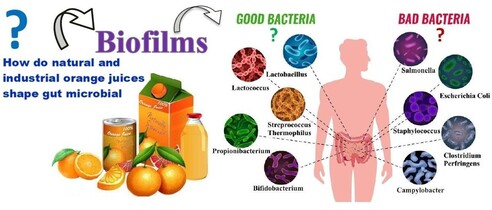
This study compares the biofilm-forming potential of Escherichia coli and Staphylococcus aureus acclimatized to two different conditions: natural orange juice and orange juice reconstituted and standardized from natural concentrate. The adhesion results predicted by the XDLVO model were compared with the experimental. Strains acclimatized to natural orange juice show significantly increased adhesion, unlike orange juice from the food industry, which considerably reduces adhesion. FTIR analyses reveal an increase in polysaccharides in strains exposed to natural juice. The results also showed the limitations of the predictive XDLVO approach, as experimental adhesion remains relatively high even when the ∆GTotal values are relatively larger and positive, which theoretically indicates weak adhesion. These results highlight the impact of bacterial acclimatization and the need to integrate biological interactions into the study of biofilm formation. They also require evaluating the link between the food environment and the behaviour of gut microbiota bacteria, with a view to preventing cross-contamination and improving food safety.
Downloads
References
Liu, Y., Zhu, H., Dou, X., Jia, K., Panagou, E. Z., Zhang, H., Xu, A., & Dong, Q., 2023, The influence of nutrients on biofilm formation of an ST87 strain of Listeria monocytogenes. LWT 191, 115658. https://doi.org/10.1016/j.lwt.2023.115658
Prado, D. B. D., Szczerepa, M. M. D. A., Capeloto, O. A., Astrath, N. G. C., Santos, N. C. A. D., Previdelli, I. T. S., Nakamura, C. V., Mikcha, J. M. G., & Abreu Filho, B. A. D., 2019, Effect of ultraviolet (UV-C) radiation on spores and biofilms of Alicyclobacillus spp. in industrialized orange juice. International Journal of Food Microbiology 305, 108238. https://doi.org/10.1016/j.ijfoodmicro.2019.108238
Margalho, L. P., Martins, C. S., Almeida, N. A., Carusi, J., Mahfouz, M. A. A. R., Sant’Ana, A. S., Nascimento, M. S., & Rocha, L. D. O., 2024, Fungi associated with orange juice production and assessment of adhesion ability and resistance to sanitizers. International Journal of Food Microbiology 430, 111035. https://doi.org/10.1016/j.ijfoodmicro.2024.111035
Pan, X., Bi, S., Lao, F., & Wu, J., 2023, Factors affecting aroma compounds in orange juice and their sensory perception: A review. Food Research International 169, 112835. https://doi.org/10.1016/j.foodres.2023.112835
Madani, A., Esfandiari, Z., Shoaei, P., & Ataei, B., 2022, Evaluation of virulence factors, antibiotic resistance, and biofilm formation of Escherichia coli isolated from milk and dairy products in Isfahan, Iran. Foods 11(7), 960. https://doi.org/10.3390/foods11070960
Yoshii, Y., Okuda, K.-I., Yamada, S., Nagakura, M., Sugimoto, S., Nagano, T., Okabe, T., Kojima, H., Iwamoto, T., Kuwano, K., & Mizunoe, Y., 2017, Norgestimate inhibits staphylococcal biofilm formation and resensitizes methicillin-resistant Staphylococcus aureus to β-lactam antibiotics. npj Biofilms and Microbiomes 3(1), 18. https://doi.org/10.1038/s41522-017-0026-1
Benjelloun, G. R., Bahlaouan, B., Rizki, H., Waddi, K., Asbai, Z., Bennani, M., Foughal, T., El Antri, S., & Boutaleb, N., 2024, Effect of food environment on the ability of microorganisms to form biofilms. Journal of Food Safety 44(2), e13120. https://doi.org/10.1111/jfs.13120
Hassan, I. A., Ekum, M. I., & Ogunsanya, A., 2021, Antibacterial activity of sweet orange (Citrus sinensis) juice extract on selected bacteria. African Journal of Microbiology Research 15(4), 178–182. https://doi.org/10.5897/ajmr2020.9387
Boutaleb, N., Latrache, H., & Sire, O., 2008, Interactions bactéries-matériaux dans les canalisations d’eau potable: rôle des propriétés physico-chimiques de surface sur le pouvoir d’adhésion. Techniques Sciences Méthodes 11, 73–80. https://doi.org/10.1051/tsm/200811073
El Omari, H., Boutaleb, N., Lazar, S., & El Antri, S., 2018, Canalisations d’eau potable : une nouvelle formulation de tubes PVC antibiofilm. Eau, l'Industrie, les Nuisances 407, 96-101. https://www.scopus.com/record/display.uri?eid=2-s2.0-85041960707&origin=inward&txGid=1c0e0b835112b238011711298013b723
Van Oss, C. J., Good, R. J., & Chaudhury, M. K., 1988, Additive and nonadditive surface tension components and the interpretation of contact angles. Langmuir 4(4), 884–891. https://doi.org/10.1021/la00082a018
Van Oss, C. J., Good, R. J., & Chaudhury, M. K., 1986, The role of van der Waals forces and hydrogen bonds in ‘hydrophobic interactions’ between biopolymers and low energy surfaces. Journal of Colloid and Interface Science 111(2), 378–390. https://doi.org/10.1016/0021-9797(86)90041-X
Hamadi, F., & Latrache, H., 2008, Comparison of contact angle measurement and microbial adhesion to solvents for assaying electron donor–electron acceptor (acid–base) properties of bacterial surface. Colloids and Surfaces B: Biointerfaces 65(1), 134–139. https://doi.org/10.1016/j.colsurfb.2008.03.010
Sheng, X., Ting, Y. P., & Pehkonen, S. O., 2008, The influence of ionic strength, nutrients and pH on bacterial adhesion to metals. Journal of Colloid and Interface Science 321(2), 256–264. https://doi.org/10.1016/j.jcis.2008.02.038
Doan, N. T., Quan, N. V., Anh, L. H., Duc, N. D., & Xuan, T. D., 2025, Exploring the potential of chitosan–phytochemical composites in preventing the contamination of antibiotic-resistant bacteria on food surfaces: a review. Molecules 30(3), 455. https://doi.org/10.3390/molecules30030455
Elgoulli, N. M., Zahir, N. H., Aitlahbib, N. O., Ellouali, N. M., Mliji, N. E. M., & Latrache, N. H., 2021, Effect of chemical compounds in water on surface properties and adhesion capacity of Pseudomonas aeruginosa and Escherichia coli in turbulent conditions. Water SA 47(4), 430–436. https://doi.org/10.17159/wsa/2021.v47.i4.3859
Jha, S., Bhadani, N. K., Kumar, A., & Sengupta, T. K., 2021, Glucose-induced biofilm formation in Bacillus thuringiensis KPWP1 is associated with increased cell surface hydrophobicity and increased production of exopolymeric substances. Current Microbiology 79(1), 24. https://doi.org/10.1007/s00284-021-02699-z
Kaur, N., & Dey, P., 2022, Bacterial exopolysaccharides as emerging bioactive macromolecules: from fundamentals to applications. Research in Microbiology 174(4), 104024. https://doi.org/10.1016/j.resmic.2022.104024
Mıdık, F., Tokatlı, M., Elmacı, S. B., & Özçelik, F., 2020, Influence of different culture conditions on exopolysaccharide production by indigenous lactic acid bacteria isolated from pickles. Archives of Microbiology 202(4), 875–885. https://doi.org/10.1007/s00203-019-01799-6
Cheng, X., Huang, L., & Li, K.-T., 2019, Antioxidant activity changes of exopolysaccharides with different carbon sources from Lactobacillus plantarum LPC-1 and its metabolomic analysis. World Journal of Microbiology and Biotechnology 35(5), 68. https://doi.org/10.1007/s11274-019-2645-6
AlKanderi, S., AlFreeh, M., Bhardwaj, R. G., & Karched, M., 2023, Sugar substitute stevia inhibits biofilm formation, exopolysaccharide production, and downregulates the expression of streptococcal genes involved in exopolysaccharide synthesis. Dentistry Journal 11(12), 267. https://doi.org/10.3390/dj11120267
Dobson, L. F., & O’Shea, D. G., 2008, Antagonistic effect of divalent cations Ca²⁺ and Mg²⁺ on the morphological development of Streptomyces hygroscopicus var. geldanus. Applied Microbiology and Biotechnology 81(1), 119–126. https://doi.org/10.1007/s00253-008-1627-7
Han, Z., Qi, P., Zhao, Y., Guo, N., Yan, H., Tucker, M. E., Li, D., Wang, J., & Zhao, H., 2022, High Mg/Ca molar ratios promote protodolomite precipitation induced by the extreme halophilic bacterium Vibrio harveyi QPL2. Frontiers in Microbiology 13, 821968. https://doi.org/10.3389/fmicb.2022.821968
Hamadi, F., Latrache, H., Zahir, H., El Abed, S., Ellouali, M., & Saad, I. K., 2012, The relation between the surface chemical composition of Escherichia coli and their electron donor/electron acceptor (acid–base) properties. Research Journal of Microbiology 7(1), 32–40. https://doi.org/10.3923/jm.2012.32.40
Bayoudh, S., Othmane, A., Bettaieb, F., Bakhrouf, A., Ben Ouada, H., & Ponsonnet, L., 2006, Quantification of the adhesion free energy between bacteria and hydrophobic and hydrophilic substrata. Materials Science and Engineering: C 26(2–3), 300–305. https://doi.org/10.1016/j.msec.2005.10.045
Jia, K., Wang, G., Liang, L., Wang, M., Wang, H., & Xu, X., 2017, Preliminary transcriptome analysis of mature biofilm and planktonic cells of Salmonella Enteritidis exposed to acid stress. Frontiers in Microbiology 8, 1861. https://doi.org/10.3389/fmicb.2017.01861
Yang, Y., Mikš-Krajnik, M., Zheng, Q., Lee, S. B., Lee, S. C., & Yuk, H. G., 2016, Biofilm formation of Salmonella Enteritidis under food-related environmental stress conditions and its subsequent resistance to chlorine treatment. Food Microbiology 54, 98–105. https://doi.org/10.1016/j.fm.2015.10.010
Al-Fhdawi, A. A. H., & Rabee, A. M., 2023, Influence of pH on virulence genes of Pseudomonas aeruginosa analyzed by RT-PCR method. Arab Gulf Journal of Scientific Research 42(2), 280–289. https://doi.org/10.1108/agjsr-10-2022-0244
Savijoki, K., Nyman, T. A., Kainulainen, V., Miettinen, I., Siljamäki, P., Fallarero, A., Sandholm, J., Satokari, R., & Varmanen, P., 2019, Growth mode and carbon source impact the surfaceome dynamics of Lactobacillus rhamnosus GG. Frontiers in Microbiology 10, 1272. https://doi.org/10.3389/fmicb.2019.01272
Lade, H., Park, J. H., Chung, S. H., Kim, I. H., Kim, J.-M., Joo, H.-S., & Kim, J.-S., 2019, Biofilm formation by Staphylococcus aureus clinical isolates is differentially affected by glucose and sodium chloride supplemented culture media. Journal of Clinical Medicine 8(11), 1853. https://doi.org/10.3390/jcm8111853
Xiong, F., Wen, D., & Li, Q., 2022, Calcium-mediated regulation promotes the biofilm formation of two novel pyridine-degrading bacteria. Frontiers in Environmental Science 10, 815528. https://doi.org/10.3389/fenvs.2022.815528
Dechiraju, H., Li, Y., Comerci, C., Luo, L., Figuerres, S., Asefi, N., Trevino, A., Barbee, A., Tebyani, M., Baniya, P., Teodorescu, M., Süel, G., & Rolandi, M., 2024, Bioelectronic delivery of potassium ions controls membrane voltage and growth dynamics in bacteria biofilms. Biomedical Materials & Devices 3, 646–654. https://doi.org/10.1007/s44174-024-00209-w
Oknin, H., Steinberg, D., & Shemesh, M., 2015, Magnesium ions mitigate biofilm formation of Bacillus species via downregulation of matrix genes expression. Frontiers in Microbiology 6, 907. https://doi.org/10.3389/fmicb.2015.00907
Javier, L., Pulido-Beltran, L., Kruithof, J., Vrouwenvelder, J. S., & Farhat, N. M., 2021, Phosphorus concentration in water affects the biofilm community and the produced amount of extracellular polymeric substances in reverse osmosis membrane systems. Membranes 11(12), 928. https://doi.org/10.3390/membranes11120928
Yuk, H., & Marshall, D. L., 2003, Heat adaptation alters Escherichia coli O157:H7 membrane lipid composition and verotoxin production. Applied and Environmental Microbiology 69(9), 5115–5119. https://doi.org/10.1128/aem.69.9.5115-5119.2003
Raskovic, D., Alvarado, G., Hines, K. M., Xu, L., Gatto, C., Wilkinson, B. J., & Pokorny, A., 2025, Growth of Staphylococcus aureus in the presence of oleic acid shifts the glycolipid fatty acid profile and increases resistance to antimicrobial peptides. Biochimica et Biophysica Acta (BBA) - Biomembranes 1867(1), 184395. https://doi.org/10.1016/j.bbamem.2024.184395
Chiou, R. Y.-Y., Phillips, R. D., Zhao, P., Doyle, M. P., & Beuchat, L. R., 2004, Ethanol-mediated variations in cellular fatty acid composition and protein profiles of two genotypically different strains of Escherichia coli O157:H7. Applied and Environmental Microbiology 70(4), 2204–2210. https://doi.org/10.1128/AEM.70.4.2204-2210.2004
Flemming, H.-C., & Wingender, J., 2010, The biofilm matrix. Nature Reviews Microbiology 8(9), 623–633. https://doi.org/10.1038/nrmicro2415
Downloads
Additional Files
Published
How to Cite
Issue
Section
License
Copyright (c) 2025 Ghita Radi Benjelloun, FatimaZahra Boutaleb, Zakaria Asbai, Mohamed Bennani, Assya Aharrar, Khadija Khataby, Fatima Hamadi, Ikrame Charef, Rajaa Tesse

This work is licensed under a Creative Commons Attribution-NonCommercial 4.0 International License.
This work is licensed under a Creative Commons Attribution-NonCommercial 4.0 International License (CC BY-NC 4.0).
Readers may copy, distribute, and adapt the work for non-commercial purposes, provided the original author and source are credited.
For full licence details, please visit https://creativecommons.org/licenses/by-nc/4.0/.