Eryngium Ilicifolium: A Review of its Botanical, Chemical, and Medicinal Properties
DOI:
https://doi.org/10.63095/NBSEH.25.691080Keywords:
Eryngium ilicifolium, Antibacterial activity, Bioactive compoundsAbstract
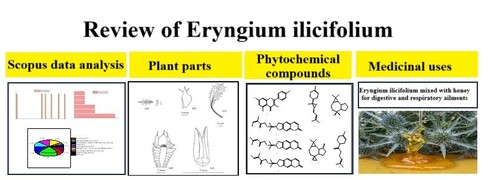
Researchers identified 250 species in the Eryngium genus used as traditional medicines. These plants have been exploited to treat various diseases like hypertension, asthma, digestive issues, and infections. Studies show promising biological activities and bioactive compounds in many Eryngium species. The aim of the present study was to review the literature on Eryngium ilicifolium. The databases used were Google Scholar, Elsevier, Medline, Web of Science and Scopus. Eryngium ilicifolium, belonging to Apiaceae, a common plant in the Mediterranean (Morocco, Algeria, Tunisia), has a long history of use in traditional medicine. Eryngium ilicifolium has been used as a mixture with honey or orange juice to treat digestive issues, gastritis, colds, rheumatoid arthritis, treatment of angina, laryngitis and pharyngitis. Chemical analysis of this plant reveals the presence of potentially beneficial compounds (Oxygenated Sesquiterpenes, Terpenes Sterols, Gallic Tannins, and Saponins Quinones). Studies using extracts of Eryngium ilicifolium show some effectiveness against microorganisms.
Downloads
References
Capetanos, C., Saroglou, V., Marin, P.D., Simić, A., & Skaltsa, H.D., 2007, Essential oil analysis of two endemic Eryngium species from Serbia. Journal of the Serbian Chemical Society 72(10), 961-965. https://doi.org/10.2298/JSC0710961C
Muckensturm, B., Boulanger, A., Farahi, M., & Reduron, J.P., 2010, Secondary metabolites from Eryngium species. Natural Product Research 24(5), 391-397. https://doi.org/10.1080/14786410701768303
Wörz, A., & Diekmann, H., 2010, Classification and evolution of the genus Eryngium L.(Apiaceae-Saniculoideae): results of fruit anatomical and petal morphological studies, Plant Diversity and Evolution 128(3-4), 387-408. https://doi.org/10.1127/1869-6155/2010/0128-0018
Merghache, D., Boucherit-Otmani, Z., Merghache, S., Chikhi, I., Selles, C., & Boucherit, K., 2014, Chemical composition, antibacterial, antifungal and antioxidant activities of Algerian Eryngium tricuspidatum L. essential oil. Natural Product Research 28(11), 795-807. https://doi.org/10.1080/14786419.2014.883392
Warda, K., Markouk, M., Bekkouche, K., Larhsini, M., Abbad, A., Romane, A., & Bouskraoui, M., 2009, Antibacterial evaluation of selected Moroccan medicinal plants against Streptococcus pneumoniae. African Journal of Pharmacy and Pharmacology 3(3), 101-104. Available online at: https://www.academia.edu/download/111277526/Warda_20101-104.pdf (accessed on 28 April 2025).
Daneshzadeh, M. S., Abbaspour, H., Amjad, L., & Nafchi, A. M., 2020, An investigation on phytochemical, antioxidant and antibacterial properties of extract from Eryngium billardieri F. Delaroche. Journal of Food Measurement and Characterization 14, 708-715. https://doi.org/10.1007/s11694-019-00317-y
Venditti, A., Frezza, C., Salutari, G., di Cecco, M., Ciaschetti, G., Oliva, A., Angelis M.D., Vullo V., Sabatino M., Garzoli S., Pepi F., Ragno R., Serafini M., & Bianco, A., 2017, Composition of the essential oil of Coristospermum cuneifolium and antimicrobial activity evaluation. Planta Medica International Open 4(02), e74-e81. https://doi.org/10.1055/s-0043-118131
Garcia, M.D., Saenz, M.T., Gomez, M.A., & Fernández, M.A., 1999, Topical antiinflammatory activity of phytosterols isolated from Eryngium foetidum on chronic and acute inflammation models. Phytotherapy Research: An International Journal Devoted to Pharmacological and Toxicological Evaluation of Natural Product Derivatives 13(1), 78-80. https://doi.org/10.1002/(SICI)1099-1573(199902)13:1<78::AID-PTR384>3.0.CO;2-F
Zhang, Z., Li, S., Ownby, S., Wang, P., Yuan, W., Zhang, W., & Beasley, R.S., 2008, Phenolic compounds and rare polyhydroxylated triterpenoid saponins from Eryngium yuccifolium. Phytochemistry 69(10), 2070-2080. https://doi.org/10.1016/j.phytochem.2008.03.020
Kartal, M., Mitaine-Offer, A.C., Abu-Asaker, M., Miyamoto, T., Calis, I., Wagner, H., & Lacaille-Dubois, M.A., 2005, Two new triterpene saponins from Eryngium campestre. Chemical and Pharmaceutical Bulletin 53(10), 1318-1320. https://doi.org/10.1248/cpb.53.1318
Zarnack, J., Hildebrandt, B., Hiller, K., & Otto, A.,1979, Isolierung von Flavonolglykosiden aus Eryngium giganteum M.B. Available online at:
http://pascal-francis.inist.fr/vibad/index.php?action=getRecordDetail&idt=PASCAL8050120279 (accessed 18 February 2025).
Erdelmeier, C.A., & Sticher, O.,1986, A cyclohexenone and a cyclohexadienone glycoside from Eryngium campestre. Phytochemistry 25(3), 741-743. https://doi.org/10.1016/0031-9422(86)88036-0.
Darriet, F., Bendahou, M., Desjobert, J.M., Costa, J., & Muselli, A., 2012, Bicyclo [4.4. 0] decane oxygenated sesquiterpenes from Eryngium maritimum essential oil. Planta Medica 78(04), 386-389. https://doi.org/10.1055/s-0031-129815
Flore du Maroc, famille des Apiaceae, Eryngium ilicifolium. Available online at: https://www.floramaroccana.fr/undefined.html (accessed 18 February 2025).
Redouan, F. Z., Benítez, G., Picone, R.M., Crisafulli, A., Yebouk, C., Bouhbal, M., Ben Drissa A., Kadiria M., Molero-Mesab J., & Merzouki, A., 2020, Traditional medicinal knowledge of apiaceae at talassemtane national park (northern Morocco). South African Journal of Botany 131, 118-130. https://doi.org/10.1016/j.sajb.2020.02.004
El Mouden, E.H., Slimani, T., Kaddour, K.B., Lagarde, F., Ouhammou, A., & Bonnet, X., 2006, Testudo graeca graeca feeding ecology in an arid and overgrazed zone in Morocco. Journal of Arid Environments 64(3), 422-435. https://doi.org/10.1016/j.jaridenv.2005.06.010
Pinar, M., & Galan, M.P.,1985, Coumarins from Eryngium ilicifolium. Available online at: https://pubs.acs.org/doi/pdf/10.1021/np50041a035 (accessed 19 February 2025).
Chaachouay, N., Azeroual, A., Bencharki, B., Douira, A., & Zidane, L., 2022, Ethnoveterinary medicinal plants for animal therapy in the Rif, North of Morocco. South African Journal of Botany 147, 176-191. https://doi.org/10.1016/j.sajb.2021.12.037
Hassani, M.E., Douiri, E.M., Bammi, J., Zidane, L., & Douira, A., 2013, Plantes médicinales de la Moyenne Moulouya (nord-est du Maroc). Ethnopharmacologia 50, 39. Available online at : http://www.ethnopharmacologia.org/prelude2020/pdf/biblio-e4-nord-el-hassani.pdf (Accessed on 28 April 2
Barkaoui, M., Katiri, A., Boubaker, H., & Msanda, F., 2017, Ethnobotanical survey of medicinal plants used in the traditional treatment of diabetes in Chtouka Ait Baha and Tiznit (Western Anti-Atlas), Morocco. Journal of Ethnopharmacology 198, 338-350. https://doi.org/10.1016/j.jep.2017.01.023
El Azzouzi, F., & Zidane, L., 2015, La flore médicinale traditionnelle de la région de Béni-Mellal (Maroc). Journal of Applied Biosciences 91, 8493-8502. https://doi.org/10.4314/jab.v91i1.8
Terrab, A., Marconi, A., Bettar, I., Msanda, F., & Díez, M. J., 2014, Palynological characterisation of Euphorbia honeys from Morocco. Palynology 38(1), 138-146. https://doi.org/10.1080/01916122.2013.871797
El Kheloui, R., Achalhi, L., Laktib, A., Elmegdar, S., Abbassi, N., Hassi, M., Msanda, F., & Hamadi, F., 2024, Effectiveness of Eryngium ilicifolium against adhesion and biofilm of carbapenem resistant Acinetobacter baumannii. International Journal of Environmental Studies 82(1), 554-570. https://doi.org/10.1080/00207233.2024.2433917
Landoulsi, A., Hennebelle, T., Bero, J., Rivière, C., Sahpaz, S., Quetin‐Leclercq, J., Neut, C., Benhamida, J., & Roumy, V. (2020). Antimicrobial and Light‐Enhanced Antimicrobial Activities, Cytotoxicity and Chemical Variability of All Tunisian Eryngium Species. Chemistry & biodiversity, 17(4), e1900543. https://doi.org/10.1002/cbdv.201900543
Breton, A., 1962, Révision des Eryngium d'Afrique du Nord. Mémoires Société des Sciences Naturelles et Physiques du Maroc. Botanique (Nouvelle série 2), 1–86. Available online at: https://www.floramaroccana.fr/files/downloads/breton-a.-1962---re-vision-des-eryngium-d-afrique-du-nord-p.p.-.pdf (accessed on 28 April 2025).
Abderrahim, O., Martin, G. J., & Abdelaziz, A., 2013, Botanical identification and ethno-medicinal uses of some underground part of medicinal plants collected and traded in Marrakech region. Journal of Medicinal Plants Research 7(29), 2165-2169. https://doi.org/10.5897/JMPR11.1597
Riekandeh, S.M., Mazandarani, M., Ebrahimzadeh, M.A., & Zargari, M., 2016, Antioxidant activities of Eryngium caucasicum inflorescence. European Review for Medical and Pharmacological Sciences 20(5), 946-949. Available online at: https://www.europeanreview.org/wp/wp-content/uploads/946-949.pdf (Accessed on 28April 2025)
Conea, S., Vlase, L., & Chirila, I., 2016, Comparative study on the polyphenols and pectin of three Eryngium species and their antimicrobial activity. Cellulose Chemistry and Technology 50(3-4), 473-481. Available online at: https://www.cellulosechemtechnol.ro/pdf/CCT3-4(2016)/p.473-481.pdf (Accessed on 28 April 2025)
Hijazi, A., Al Masri, D.S., Farhan, H., Nasser, M., Rammal, H., & Annan, H., 2015, Effect of different ethanol concentrations, using different extraction techniques, on the antioxidant capacity of Lebanese Eryngium creticum. Journal of Pharmaceutical, Chemical and Biological Sciences 3(2), 262-271. Available online at: https://www.academia.edu/download/95204178/2015_3_2_15_Hijazi.pdf (Accessed on 28 April 2025).
Saenz, M.T., Fernández, M.A., & Garcia, M.D., 1997, Antiinflammatory and analgesic properties from leaves of Eryngium foetidum L. (Apiaceae). Phytotherapy Research: An International Journal Devoted to Medical and Scientific Research on Plants and Plant Products 11(5), 380-383. https://doi.org/10.1002/(SICI)1099-1573(199708)11:5<380::AID-PTR116>3.0.CO;2-#
Crowden, R.K., Harborne, J.B., & Heywood, V.H.,1969, Chemosystematics of the Umbelliferae—a general survey. Phytochemistry 8(10), 1963-1984. https://doi.org/10.1016/S0031-9422(00)88084-X
Håkansson, A., Svensson, M., Mossberg, A.K., Sabharwal, H., Linse, S., Lazou, I., Lonnerdal B., & Svanborg, C., 2000, A folding variant of α‐lactalbumin with bactericidal activity against streptococcus pneumoniae. Molecular Microbiology 35(3), 589-600. https://doi.org/10.1046/j.1365-2958.2000.01728.x
Dalukdeniya, D.A.C.K., & Rathnayaka, R.M.U.S.K., 2017, Comparative study on antibacterial and selected antioxidant activities of different Eryngium foetidum extracts. Journal of Applied Life Sciences International 12(4), 1-7. https://doi.org/10.9734/JALSI/2017/34378
Akroum, S., 2021, Activité antimicrobienne des extraits de Rosmarinus officinalis et Zingiber officinale sur les espèces du genre Candida et sur Streptococcus pneumoniae. Annales Pharmaceutiques Francaises 79(1), 62-69. https://doi.org/10.1016/j.pharma.2020.06.003
Landoulsi, A., 2016, Etude chimiotaxonomique et activité biologique des métabolites secondaires des plantes du genre Eryngium, PhD Thesis. Université du Droit et de la Santé-Lille II, NNT: 2016LIL2S056ff. fftel-01755125.
Meot-Duros, L., Le Floch, G., & Magné, C., 2008, Radical scavenging, antioxidant and antimicrobial activities of halophytic species. Journal of Ethnopharmacology 116(2), 258-262. https://doi.org/10.1016/j.jep.2007.11.024
Celik, B. Ö., Kara, E. M., Guzel, C. B., Genç, G. E., Genç, I., Anil, S. K., & Melikoğlu, G., 2019, Evaluation of antimicrobial and cytotoxic effects of four Turkish species of Eryngium L. Bangladesh Journal of Botany 48(2), 271-278. https://doi.org/10.3329/bjb.v48i2.47549
Kartal, M., Mitaine-Offer, A.C., Paululat, T., Abu-Asaker, M., Wagner, H., Mirjolet, J.F., Guilbaud, N., & Lacaille-Dubois, M.A., 2006, Triterpene saponins from Eryngium campestre. Journal of Natural Products 69(7), 1105-1108. https://doi.org/10.1021/np060101w
Downloads
Additional Files
Published
How to Cite
Issue
Section
License
Copyright (c) 2025 Lahcen Achalhi, Najat Abbassi, Fatima Hamadi

This work is licensed under a Creative Commons Attribution-NonCommercial 4.0 International License.
This work is licensed under a Creative Commons Attribution-NonCommercial 4.0 International License (CC BY-NC 4.0).
Readers may copy, distribute, and adapt the work for non-commercial purposes, provided the original author and source are credited.
For full licence details, please visit https://creativecommons.org/licenses/by-nc/4.0/.