Application of Machine Learning for Prediction of Solid Waste Generation
DOI:
https://doi.org/10.63095/NBSEH.25.831599Keywords:
Solid Waste, Machine Learning, Prediction ModelAbstract
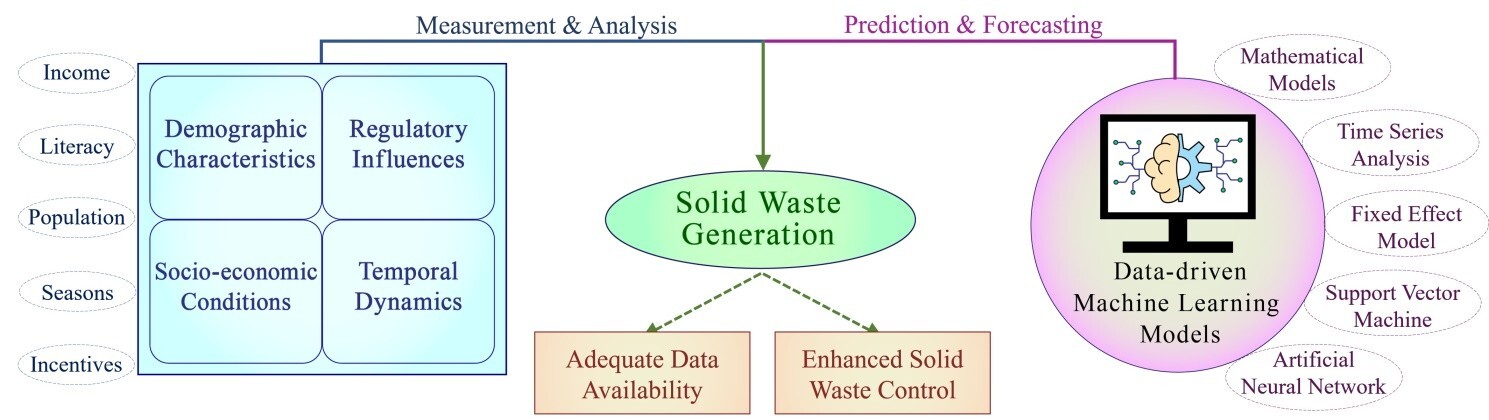
Effective solid waste management requires adaptive planning and accurate forecasting of waste generation and composition. Accurate predictions require a deep understanding of key influencing factors, including population, urbanization, income, and temporal effects, which impact waste trends. Traditional models, including regression and fixed-effects analysis, struggle to capture these complex, non-linear relationships. Recently, machine learning (ML) techniques have emerged as powerful tools, leveraging large datasets and advanced computational methods to improve predictive accuracy. Nonetheless, challenges like data limitations, regional variability, and scalability hinder their practical implementation. This review explores and summarizes the significance of the essential factors for predicting solid waste generation and emphasizes new opportunities for real-time waste monitoring by integrating ML with emerging technologies like the Internet of Things (IoT). Enhanced sustainable waste management needs advances in model generalisability, data quality, and policy integration.
Downloads
References
Kaza, S., Yao, L. C., Bhada-Tata, P., & Van Woerden, F., 2018, What a Waste 2.0: A Global Snapshot of Solid Waste Management to 2050. World Bank Publications. Available online at https://openknowledge.worldbank.org/entities/publication/d3f9d45e-115f-559b-b14f-28552410e90a (Accessed on 24 February 2025).
Makarichi, L., Jutidamrongphan, W., & Techato, K. A., 2018, The evolution of waste-to-energy incineration: A review. Renewable and Sustainable Energy Reviews 91, 812-821. https://doi.org/10.1016/j.rser.2018.04.088
Zhang, J., Zhang, S., & Liu, B., 2020, Degradation technologies and mechanisms of dioxins in municipal solid waste incineration fly ash: A review. Journal of Cleaner Production 250, 119507. https://doi.org/10.1016/j.jclepro.2019.119507
Meena, M. D., Dotaniya, M. L., Meena, B. L., Rai, P. K., Antil, R. S., Meena, H. S., Meena, L.K., Dotaniya, C. K., Meena, V. S., Ghosh A., Meena, K. N., Singh, A. K., Meena, V. D., Moharana, P. C., Meena S. K., Srinivasarao, Ch., Meena, A. L., Chatterjee, S., Meena, D. K., Prajapat, M., & Meena, R. B., 2023, Municipal solid waste: Opportunities, challenges and management policies in India: A review. Waste Management Bulletin 1(1), 4-18. https://doi.org/10.1016/j.wmb.2023.04.001
Fatimah, Y. A., Govindan, K., Murniningsih, R., & Setiawan, A., 2020, Industry 4.0 based sustainable circular economy approach for smart waste management system to achieve sustainable development goals: A case study of Indonesia. Journal of Cleaner Production 269, 122263. https://doi.org/10.1016/j.jclepro.2020.122263
Arun, C., & Sivashanmugam, P., 2017, Study on optimization of process parameters for enhancing the multi-hydrolytic enzyme activity in garbage enzyme produced from preconsumer organic waste. Bioresource Technology 226, 200-210. https://doi.org/10.1016/j.biortech.2016.12.029
Kumar, A., Singh, E., Mishra, R., Lo, S. L., & Kumar, S., 2023, Global trends in municipal solid waste treatment technologies through the lens of sustainable energy development opportunity. Energy 275, 127471. https://doi.org/10.1016/j.energy.2023.127471
Hannan, M. A., Lipu, M. H., Akhtar, M., Begum, R. A., Al Mamun, M. A., Hussain, A., Mia, M. S., & Basri, H., 2020, Solid waste collection optimization objectives, constraints, modeling approaches, and their challenges toward achieving sustainable development goals. Journal of Cleaner Production 277, 123557. https://doi.org/10.1016/j.jclepro.2020.123557
Benítez, S. O., Lozano-Olvera, G., Morelos, R. A., & de Vega, C. A., 2008, Mathematical modeling to predict residential solid waste generation. Waste Management 28, S7-S13. https://doi.org/10.1016/j.wasman.2008.03.020
Johnstone, N., & Labonne, J., 2004, Generation of household solid waste in OECD countries: an empirical analysis using macroeconomic data. Land Economics 80(4), 529-538. https://doi.org/10.2307/3655808
Ali Abdoli, M., Falah Nezhad, M., Salehi Sede, R., & Behboudian, S., 2012, Longterm forecasting of solid waste generation by the artificial neural networks. Environmental Progress & Sustainable Energy 31(4), 628-636. https://doi.org/10.1002/ep.10591
Abbasi, M., & El Hanandeh, A., 2016, Forecasting municipal solid waste generation using artificial intelligence modelling approaches. Waste Management 56, 13-22. https://doi.org/10.1016/j.wasman.2016.05.018
Ceylan, Z., 2020, Estimation of municipal waste generation of Turkey using socio-economic indicators by Bayesian optimization tuned Gaussian process regression. Waste Management & Research 38(8), 840-850. https://doi.org/10.1177/0734242X20906877
Nguyen, X. C., Nguyen, T. T. H., La, D. D., Kumar, G., Rene, E. R., Nguyen, D. D., Chang, S. W., Chung, W. J., Nguyen, X. H., Nguyen, V. K., 2021, Development of machine learning - based models to forecast solid waste generation in residential areas: A case study from Vietnam. Resources, Conservation and Recycling 167, 105381. https://doi.org/10.1016/j.resconrec.2020.105381
Zhang, C., Dong, H., Geng, Y., Liang, H., Liu, X., 2022, Machine learning based prediction for China's municipal solid waste under the shared socioeconomic pathways. Journal of Environmental Management 312, 114918. https://doi.org/10.1016/j.jenvman.2022.114918
Latif, S. D., Hazrin, N. A. B., Younes, M. K., Ahmed, A. N., & Elshafie, A., 2024, Evaluating different machine learning models for predicting municipal solid waste generation: a case study of Malaysia. Environment, Development and Sustainability 26, 12489–12512. https://doi.org/10.1007/s10668-023-03882-x
Miezah, K., Obiri-Danso, K., Kádár, Z., Fei-Baffoe, B., & Mensah, M. Y., 2015, Municipal solid waste characterization and quantification as a measure towards effective waste management in Ghana. Waste Management 46, 15-27. https://doi.org/10.1016/j.wasman.2015.09.009
Guo, H. N., Wu, S. B., Tian, Y. J., Zhang, J., & Liu, H. T., 2021, Application of machine learning methods for the prediction of organic solid waste treatment and recycling processes: A review. Bioresource Technology 319, 124114. https://doi.org/10.1016/j.biortech.2020.124114
He, R., Sandoval-Reyes, M., Scott, I., Semeano, R., Ferrao, P., Matthews, S., & Small, M. J., 2022, Global knowledge base for municipal solid waste management: Framework development and application in waste generation prediction. Journal of Cleaner Production 377, 134501. https://doi.org/10.1016/j.jclepro.2022.134501
Cipullo, S., Snapir, B., Prpich, G., Campo, P., & Coulon, F., 2019, Prediction of bioavailability and toxicity of complex chemical mixtures through machine learning models. Chemosphere 215, 388-395. https://doi.org/10.1016/j.chemosphere.2018.10.056
Kannangara, M., Dua, R., Ahmadi, L., & Bensebaa, F., 2018, Modelling and prediction of regional municipal solid waste generation and diversion in Canada using machine learning approaches. Waste Management 74, 3-15. https://doi.org/10.1016/j.wasman.2017.11.057
Jalili, M., & Noori, R., 2007, Prediction of Municipal Solid Waste Generation by Use of Artificial Neural Network: A Case Study of Mashhad. International Journal of Environmental Research 2(1), 13-22. https://doi.org/10.22059/ijer.2010.17
Singh, T., & Uppaluri, R. V. S., 2023, Machine learning tool-based prediction and forecasting of municipal solid waste generation rate: a case study in Guwahati, Assam, India. International Journal of Environmental Science and Technology 20, 12207–12230. https://doi.org/10.1007/s13762-022-04644-4
Liang, X., Ji, L., Xie, Y., & Huang, G., 2022, Economic-Environment-Energy (3E) objective-driven integrated municipal waste management under deep complexities–A novel multi-objective approach. Sustainable Cities and Society 87, 104190. https://doi.org/10.1016/j.scs.2022.104190
Sosunova, I., & Porras, J., 2022, IoT-Enabled Smart Waste Management Systems for Smart Cities: A Systematic Review, IEEE Access 10, 73326-73363. http://dx.doi.org/10.1109/ACCESS.2022.3188308
Mintz, K. K., Henn, L., Park, J., & Kurman, J., 2019, What predicts household waste management behaviors? Culture and type of behavior as moderators. Resources, Conservation and Recycling 145, 11-18. https://doi.org/10.1016/j.resconrec.2019.01.045
Namoun, A., Tufail, A., Khan, M. Y., Alrehaili, A., Syed, T. A., & BenRhouma, O., 2022, Solid Waste Generation and Disposal Using Machine Learning Approaches: A Survey of Solutions and Challenges. Sustainability 14(20), 13578. https://doi.org/10.3390/su142013578
Downloads
Additional Files
Published
How to Cite
Issue
Section
License
Copyright (c) 2025 Natural Built Social Environment Health

This work is licensed under a Creative Commons Attribution-NonCommercial 4.0 International License.
This work is licensed under a Creative Commons Attribution-NonCommercial 4.0 International License (CC BY-NC 4.0).
Readers may copy, distribute, and adapt the work for non-commercial purposes, provided the original author and source are credited.
For full licence details, please visit https://creativecommons.org/licenses/by-nc/4.0/.